708 posters, 8 topics, 16 sessions, 1,190 authors, 600 institutions
ePostersLive by SciGen Technologies S.A. All rights reserved.
ISQua's 39th International Conference 2023
August 27 - 30, 2023 | Seoul, Republic of Korea

P656
PREVENTING OPHTHALMIC SURGICAL FIRES: STRATEGIES TO REDUCE THE OXYGEN CONCENTRATION BEING ACCUMULATED UNDER SURGICAL DRAPES
Poster Presenter
Authors
Affiliations
Part of Topic
Patient Safety & Quality Improvement
PREVENTING OPHTHALMIC SURGICAL FIRES:
STRATEGIES TO REDUCE THE OXYGEN CONCENTRATION BEING ACCUMULATED UNDER SURGICAL DRAPES
Miu Nga WONG1, Suk Kuen LAI1, Geoffrey TANG2, Kenneth Li2
1Operating Room, 2Ophthalmology Department, United Christian Hospital, Hospital Authority, Hong Kong
Introduction
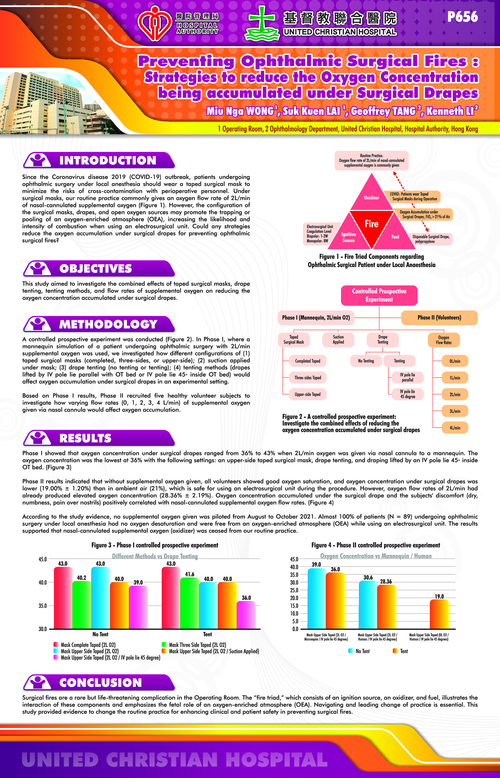
Since the Coronavirus disease 2019 (COVID-19) outbreak, patients undergoing ophthalmic surgery under local anesthesia should wear a taped surgical mask to minimize the risks of cross-contamination with perioperative personnel. Under surgical masks, our routine practice commonly gives an oxygen flow rate of 2L/min of nasal-cannulated supplemental oxygen (Figure 1). However, the configuration of the surgical masks, drapes, and open oxygen sources may promote the trapping or pooling of an oxygen-enriched atmosphere (OEA), increasing the likelihood and intensity of combustion when using an electrosurgical unit. Could any strategies reduce the oxygen accumulation under surgical drapes for preventing ophthalmic surgical fires?
Objectives
This study aimed to investigate the combined effects of taped surgical masks, drape tenting, tenting methods, and flow rates of supplemental oxygen on reducing the oxygen concentration accumulated under surgical drapes.
Methodology
A controlled prospective experiment was conducted (Figure 2). In Phase I, where a mannequin simulation of a patient undergoing ophthalmic surgery with 2L/min supplemental oxygen was used, we investigated how different configurations of (1) taped surgical masks (completed, three-sides, or upper-side); (2) suction applied under mask; (3) drape tenting (no tenting or tenting); (4) tenting methods (drapes lifted by IV pole lie parallel with OT bed or IV pole lie 45⸰ inside OT bed) would affect oxygen accumulation under surgical drapes in an experimental setting.
Based on Phase I results, Phase II recruited five healthy volunteer subjects to investigate how varying flow rates (0, 1, 2, 3, 4 L/min) of supplemental oxygen given via nasal cannula would affect oxygen accumulation.
Results
Phase I showed that oxygen concentration under surgical drapes ranged from 36% to 43% when 2L/min oxygen was given via nasal cannula to a mannequin. The oxygen concentration was the lowest at 36% with the following settings: an upper-side taped surgical mask, drape tenting, and draping lifted by an IV pole lie 45⸰ inside OT bed. (Figure 3)
Phase II results indicated that without supplemental oxygen given, all volunteers showed good oxygen saturation, and oxygen concentration under surgical drapes was lower (19.00% ± 1.20%) than in ambient air (21%), which is safe for using an electrosurgical unit during the procedure. However, oxygen flow rates of 2L/min had already produced elevated oxygen concentration (28.36% ± 2.19%). Oxygen concentration accumulated under the surgical drape and the subjects' discomfort (dry, numbness, pain over nostrils) positively correlated with nasal-cannulated supplemental oxygen flow rates. (Figure 4)
According to the study evidence, no supplemental oxygen given was piloted from August to October 2021. Almost 100% of patients (N = 89) undergoing ophthalmic surgery under local anesthesia had no oxygen desaturation and were free from an oxygen-enriched atmosphere (OEA) while using an electrosurgical unit. The results supported that nasal-cannulated supplemental oxygen (oxidizer) was ceased from our routine practice.
Conclusion
Surgical fires are a rare but life-threatening complication in the Operating Room. The “fire triad,” which consists of an ignition source, an oxidizer, and fuel, illustrates the interaction of these components and emphasizes the fetal role of an oxygen-enriched atmosphere (OEA). Navigating and leading change of practice is essential. This study provided evidence to change the routine practice for enhancing clinical and patient safety in preventing surgical fires.