708 posters, 8 topics, 16 sessions, 1,190 authors, 600 institutions
ePostersLive by SciGen Technologies S.A. All rights reserved.
ISQua's 39th International Conference 2023
August 27 - 30, 2023 | Seoul, Republic of Korea

P650
ENHANCING THE PALLIATIVE CARE NEEDS RE‑EVALUATION BY SPECIALIST PHYSICIANS IN TAIPEI
Part of Topic
Patient Safety & Quality Improvement
Enhancing the palliative care needs re-evaluation by specialist physicians in Taipei
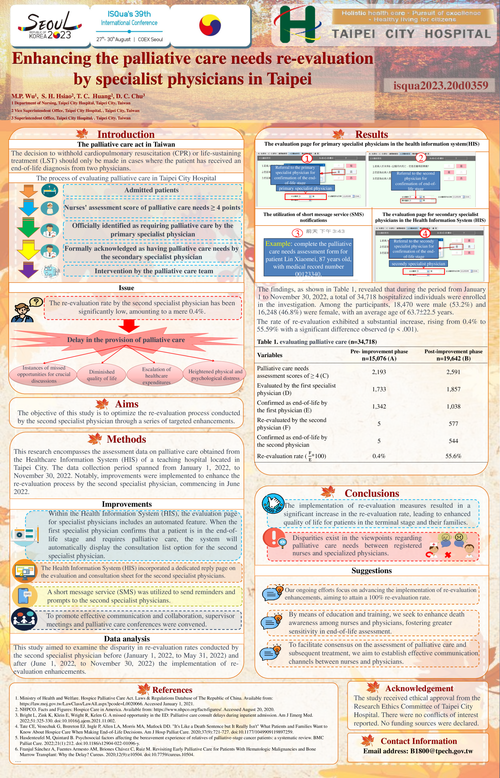
Introduction
The palliative care act in Taiwan
The decision to withhold cardiopulmonary resuscitation (CPR) or life-sustaining treatment (LST) should only be made in cases where the patient has received an end-of-life diagnosis from two physicians.
The process of evaluating palliative care in Taipei City Hospital
1.Admitted patients
2.Nurses' assessment score of palliative care needs ≥ 4 points
3.Officially identified as requiring palliative care by the primary specialist physician
4.Formally acknowledged as having palliative care needs by the secondary specialist physician
5.Intervention by the palliative care team
Issue
The re-evaluation rate by the second specialist physician has been significantly low, amounting to a mere 0.4%.
Delay in the provision of palliative care may cause Instances of missed opportunities for crucial discussions、Diminished quality of life、Escalation of healthcare expenditures、Heightened physical and psychological distress
Aims
The objective of this study is to optimize the re-evaluation process conducted by the second specialist physician through a series of targeted enhancements.
Methods
This research encompasses the assessment data on palliative care obtained from the Healthcare Information System (HIS) of a teaching hospital located in Taipei City. The data collection period spanned from January 1, 2022, to November 30, 2022. Notably, improvements were implemented to enhance the re-evaluation process by the second specialist physician, commencing in June 2022.
Improvements
1.Within the Health Information System (HIS), the evaluation page for specialist physicians includes an automated feature. When the first specialist physician confirms that a patient is in the end-of-life stage and requires palliative care, the system will automatically display the consultation list option for the second specialist physician.
2.The Health Information System (HIS) incorporated a dedicated reply page on the evaluation and consultation sheet for the second specialist physicians.
3.A short message service (SMS) was utilized to send reminders and prompts to the second specialist physicians.
4.To promote effective communication and collaboration, supervisor meetings and palliative care conferences were convened.
Data analysis
This study aimed to examine the disparity in re-evaluation rates conducted by the second specialist physician before (January 1, 2022, to May 31, 2022) and after (June 1, 2022, to November 30, 2022) the implementation of re-evaluation enhancements.
Results
The findings, as shown in Table 1, revealed that during the period from January 1 to November 30, 2022, a total of 34,718 hospitalized individuals were enrolled in the investigation. Among the participants, 18,470 were male (53.2%) and 16,248 (46.8%) were female, with an average age of 63.7±22.5 years.
The rate of re-evaluation exhibited a substantial increase, rising from 0.4% to 55.59% with a significant difference observed (p < .001).
Conclusions
The implementation of re-evaluation measures resulted in a significant increase in the re-evaluation rate, leading to enhanced quality of life for patients in the terminal stage and their families.
Disparities exist in the viewpoints regarding palliative care needs between registered nurses and specialized physicians.
Suggestions
1.Our ongoing efforts focus on advancing the implementation of re-evaluation enhancements, aiming to attain a 100% re-evaluation rate.
2.By means of education and training, we seek to enhance death awareness among nurses and physicians, fostering greater sensitivity in end-of-life assessment.
3. To facilitate consensus on the assessment of palliative care and subsequent treatment, we aim to establish effective communication channels between nurses and physicians.