708 posters, 8 topics, 16 sessions, 1,190 authors, 600 institutions
ePostersLive by SciGen Technologies S.A. All rights reserved.
ISQua's 39th International Conference 2023
August 27 - 30, 2023 | Seoul, Republic of Korea

P649
THE RISK OF OVER-ANTICOAGULATION DURING CONCOMITANT TREATMENT OF WARFARIN AND PROTON PUMP INHIBITORS
Poster Presenter
Authors
Affiliations
Part of Topic
Patient Safety & Quality Improvement
The risk of over-anticoagulation during concomitant treatment of warfarin and proton pump inhibitors
Introduction
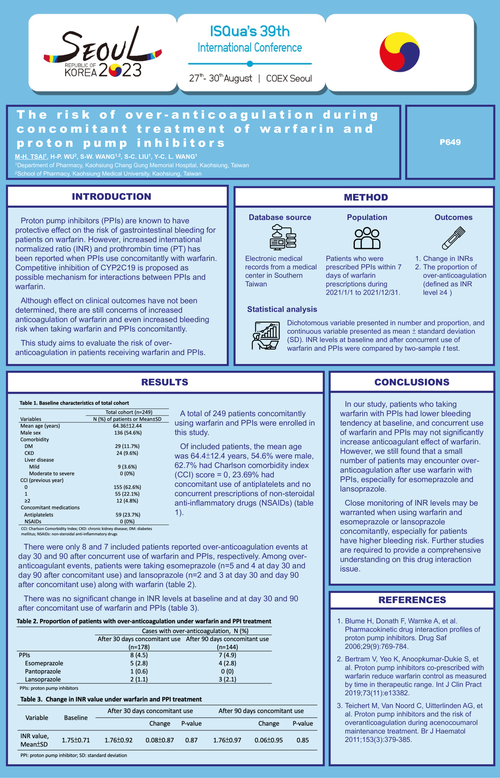
Proton pump inhibitors (PPIs) are known to have protective effect on the risk of gastrointestinal bleeding for patients on warfarin. However, increased international normalized ratio (INR) and prothrombin time (PT) has been reported when PPIs use concomitantly with warfarin. Competitive inhibition of CYP2C19 is proposed as possible mechanism for interactions between PPIs and warfarin. Although effect on clinical outcomes have not been determined, there are still concerns of increased anticoagulation of warfarin and even increased bleeding risk when taking warfarin and PPIs concomitantly. This study aims to evaluate the risk of over-anticoagulation in patients receiving warfarin and PPIs.
Methods
This study was conducted by using electronic medical records from a medical center in Southern Taiwan. Patients who were concomitantly prescribed PPIs within 7 days of warfarin prescriptions during January 1, 2021 to December 31, 2021 were included. Baseline characteristics including age, sex, comorbidities and concomitant medications were collected. The study endpoints included change in INR value and the proportion of over-anticoagulation, which defined as INR level ≥4. Dichotomous variable presented in number and proportion, and continuous variable presented as mean ± standard deviation (SD). INR levels at baseline and after concurrent use of warfarin and PPIs were compared by two-sample t test.
Results
A total of 249 patients concomitantly using warfarin and PPIs were enrolled in this study. Of included subjects, the mean age was 64.4±12.4 years, 54.6% were male, 62.7% had Charlson comorbidity index (CCI) score =0, 23.69% had concomitant use of antiplatelets and no concurrent prescriptions of non-steroidal anti-inflammatory drugs (NSAIDs). There were only 8 and 7 included patients reported over-anticoagulation events at day 30 and 90 after concurrent use of warfarin and PPIs, respectively. Among over-anticoagulant events, patients were taking esomeprazole (n=5 at day 30 after concomitant use; n=4 at day 90 after concomitant use) and lansoprazole (n=2 at day 30 after concomitant use; n=3 at day 90 after concomitant use) along with warfarin. There was no significant change in INR levels at baseline and at day 30 and 90 after concomitant use of warfarin and PPIs.
Conclusions
In our study, patients who taking warfarin with PPIs had lower bleeding tendency at baseline, and concurrent use of warfarin and PPIs may not significantly increase anticoagulant effect of warfarin. However, we still found that a small number of patients may encounter over-anticoagulation after use warfarin with PPIs, especially for esomeprazole and lansoprazole. Close monitoring of INR levels may be warranted when using warfarin and esomeprazole or lansoprazole concomitantly, especially for patients have higher bleeding risk. Further studies are required to provide a comprehensive understanding on this drug interaction issue.