708 posters, 8 topics, 16 sessions, 1,190 authors, 600 institutions
ePostersLive by SciGen Technologies S.A. All rights reserved.
ISQua's 39th International Conference 2023
August 27 - 30, 2023 | Seoul, Republic of Korea

P642
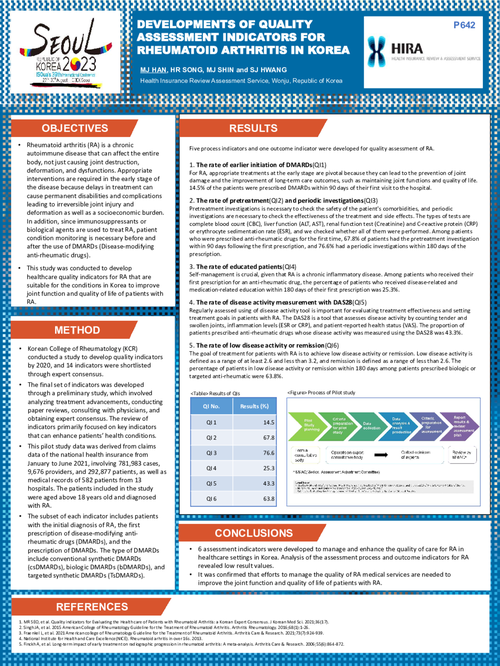
DEVELOPMENT OF QUALITY ASSESSMENT INDICATORS FOR RHEUMATOID ARTHRITIS IN KOREA
Poster Presenter
Authors
Affiliations
Part of Topic
Patient Safety & Quality Improvement
OBJECTIVES
• Rheumatoid arthritis (RA) is a chronic autoimmune disease that can affect the entire body, not just causing joint destruction, deformation, and dysfunctions. Appropriate interventions are required in the early stage of the disease because delays in treatment can cause permanent disabilities and complications leading to irreversible joint injury and deformation as well as a socioeconomic burden. In addition, since immunosuppressants or biological agents are used to treat RA, patient condition monitoring is necessary before and after the use of DMARDs (Disease-modifying anti-rheumatic drugs).
• This study was conducted to develop healthcare quality indicators for RA that are suitable for the conditions in Korea to improve joint function and quality of life of patients with RA.
METHOD
• Korean College of Rheumatology (KCR) conducted a study to develop quality indicators by 2020, and 14 indicators were shortlisted through expert consensus.
• The final set of indicators was developed through a preliminary study, which involved analyzing treatment advancements, conducting paper reviews, consulting with physicians, and obtaining expert consensus. The review of indicators primarily focused on key indicators that can enhance patients’ health conditions.
• This pilot study data was derived from claims data of the national health insurance from January to June 2021, involving 781,983 cases, 9,676 providers, and 292,877 patients, as well as medical records of 582 patients from 13 hospitals. The patients included in the study were aged above 18 years old and diagnosed with RA.
• The subset of each indicator includes patients with the initial diagnosis of RA, the first prescription of disease-modifying anti-rheumatic drugs (DMARDs), and the prescription of DMARDs. The type of DMARDs include conventional synthetic DMARDs (csDMARDs), biologic DMARDs (bDMARDs), and targeted synthetic DMARDs (TsDMARDs).
RESULTS
• Five process indicators and one outcome indicator were developed for quality assessment of RA.
1. The rate of earlier initiation of DMARDs(QI1)
For RA, appropriate treatments at the early stage are pivotal because they can lead to the prevention of joint damage and the improvement of long-term care outcomes, such as maintaining joint functions and quality of life. 14.5% of the patients were prescribed DMARDs within 90 days of their first visit to the hospital.
2. The rate of pretreatment(QI2) and periodic investigations(QI3)
Pretreatment investigations is necessary to check the safety of the patient's comorbidities, and periodic investigations are necessary to check the effectiveness of the treatment and side effects. The types of tests are complete blood count (CBC), liver function (ALT, AST), renal function test (Creatinine) and C-reactive protein (CRP) or erythrocyte sedimentation rate (ESR), and we checked whether all of them were performed. Among patients who were prescribed anti-rheumatic drugs for the first time, 67.8% of patients had the pretreatment investigation within 90 days following the first prescription, and 76.6% had a periodic investigations within 180 days of the prescription.
3. The rate of educated patients(QI4)
Self-management is crucial, given that RA is a chronic inflammatory disease. Among patients who received their first prescription for an anti-rheumatic drug, the percentage of patients who received disease-related and medication-related education within 180 days of their first prescription was 25.3%.
4. The rate of disease activity measurement with DAS28(QI5)
Regularly assessed using of disease activity tool is important for evaluating treatment effectiveness and setting treatment goals in patients with RA. The DAS28 is a tool that assesses disease activity by counting tender and swollen joints, inflammation levels (ESR or CRP), and patient-reported health status (VAS). The proportion of patients prescribed anti-rheumatic drugs whose disease activity was measured using the DAS28 was 43.3%.
5. The rate of low disease activity or remission(QI6)
The goal of treatment for patients with RA is to achieve low disease activity or remission. Low disease activity is defined as a range of at least 2.6 and less than 3.2, and remission is defined as a range of less than 2.6. The percentage of patients in low disease activity or remission within 180 days among patients prescribed biologic or targeted anti-rheumatic were 63.8%.
CONCLUSIONS
• 6 assessment indicators were developed to manage and enhance the quality of care for RA in healthcare settings in Korea. Analysis of the assessment process and outcome indicators for RA revealed low result values.
• It was confirmed that efforts to manage the quality of RA medical services are needed to improve the joint function and quality of life of patients with RA.
REFERENCES
1. MR SEO, et al. Quality indicators for Evaluating the Health care of Patients with Rheumatoid Arthritis: a Korean Expert Consensus. J Korean Med Sci. 2021;36(17).
2. Singh JA, et al. 2015 American College of Rheumatology Guideline for the Treatment of Rheumatoid Arthritis. Arthritis Rheumatology. 2016;68(1):1-26.
3. Fraenkel L, et al. 2021 American college of Rheumatology Guideline for the Treatment of Rheumatoid Arthritis. Arthritis Care & Research. 2021;73(7):924-939.
4. National Institute for Health and Care Excellence(NICE). Rheumatoid arhritis in over 16s. 2013.
5. Finckh A, et al. Long-term impact of early treatment on radiographic progression in rheumatoid arthritis: A meta-analysis. Arthritis Care & Research. 2006;55(6):864-872.