708 posters, 8 topics, 16 sessions, 1,190 authors, 600 institutions
ePostersLive by SciGen Technologies S.A. All rights reserved.
ISQua's 39th International Conference 2023
August 27 - 30, 2023 | Seoul, Republic of Korea

ISQUA2023-ABS-1697
CUE UTILISATION REDUCES THE IMPACT OF RESPONSE BIAS IN HISTOPATHOLOGY
Poster Presenter
Authors
Ann Carrigan, Amanda Charlton, Mark Wiggins, Kim Curby, Andrew Georgiou, Tony Badrick, Thomas Palmeri
Affiliations
Macquarie University, Australian Institute of Health Innovation, Macquarie University, Sydney, Australia. Centre for Elite Performance, Expertise & Training, Macquarie University, Sydney, Australia., Department of Histopathology, Auckland City Hospital, and Department of Molecular Medicine and Pathology, University of Auckland, New Zealand., School of Psychological Sciences, Macquarie University, Sydney, Australia. Centre for Elite Performance, Expertise & Training, Macquarie University, Sydney, Australia., Centre for Health Systems and Safety Research, Macquarie University, Sydney, Australia., RCCPA Quality Assurance Programs, Sydney, Australia., Department of Psychology, Vanderbilt University, Nashville, United States.
Part of Topic
Patient Safety & Quality Improvement
Cue utilisation reduces the impact
of response bias in histopathology:
Where to from here?
Ann Carrigan, PhD1,2, Amanda Charlton, MD, FRCPA3, Mark Wiggins, PhD4,2 , Kim Curby, PhD4,2 Andrew Georgiou, PhD5, Tony Badrick6 &Thomas Palmeri, PhD7
INTRODUCTION
-
Typically, histopathologists test the working diagnoses derived from cases that have already been classified as ‘abnormal’ by clinical examination and/or other diagnostic tests. For example, surgical incision for polyps.
-
Consequently, disease prevalence tends to be high. Specimens are also accompanied by a clinical report which likely creates an environment where there is the potential for ‘abnormality priming’, and a response bias leading to false positives on normal cases.
-
PREVIOUS STUDY
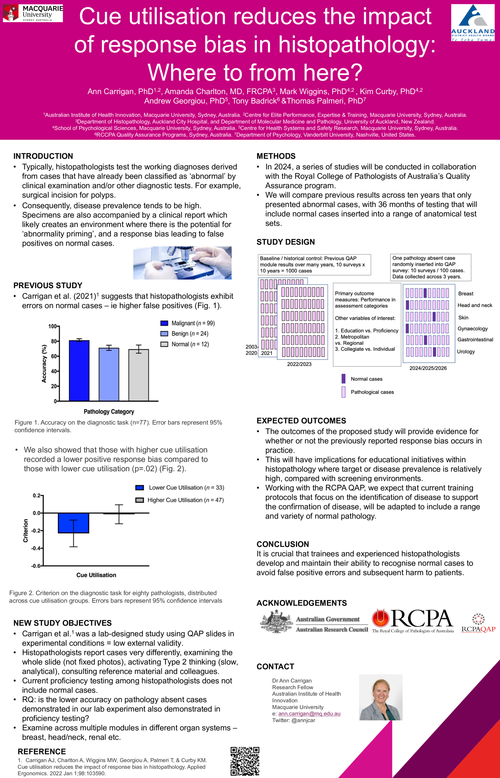
• Carrigan et al. (2021)1 suggests that histopathologists exhibit errors on normal cases – ie higher false positives (Fig. 1).
NEW STUDY OBJECTIVES
-
Carrigan et al.1 was a lab-designed study using QAP slides in experimental conditions = low external validity.
-
Histopathologists report cases very differently, examining the whole slide (not fixed photos), activating Type 2 thinking (slow, analytical), consulting reference material and colleagues.
-
Current proficiency testing among histopathologists does not include normal cases.
-
RQ: is the lower accuracy on pathology absent cases demonstrated in our lab experiment also demonstrated in proficiency testing?
-
Examine across multiple modules in different organ systems – breast, head/neck, renal etc.
METHODS
- In 2024, a series of studies will be conducted in collaboration with the Royal College of Pathologists of Australia’s Quality Assurance program
• We will compare previous results across ten years that only presented abnormal cases, with 36 months of testing that will include normal cases inserted into a range of anatomical test sets.
EXPECTED OUTCOMES
-
The outcomes of the proposed study will provide evidence for whether or not the previously reported response bias occurs in practice.
-
This will have implications for educational initiatives within histopathology where target or disease prevalence is relatively high, compared with screening environments.
-
Working with the RCPA QAP, we expect that current training protocols that focus on the identification of disease to support the confirmation of disease, will be adapted to include a range and variety of normal pathology.
CONCLUSION
It is crucial that trainees and experienced histopathologists develop and maintain their ability to recognise normal cases to avoid false positive errors and subsequent harm to patients.