708 posters, 8 topics, 16 sessions, 1,190 authors, 600 institutions
ePostersLive by SciGen Technologies S.A. All rights reserved.
ISQua's 39th International Conference 2023
August 27 - 30, 2023 | Seoul, Republic of Korea

ISQUA2023-ABS-1887
WHAT PERCEPTION AND EXPECTATION IS FOR PAID CAREGIVERS: A QUALITATIVE STUDY FOCUSED ON INPATIENTS AND THEIR RELATIVES
Poster Presenter
Authors
Qingqing Liu, Zirong Tao, Lingli Peng, Qingqing Liu, Chun Huang
Affiliations
Xiangya Hospital of Central South University, Teaching and Research Section of Clinical Nursing, Xiangya Hospital of Central South University / Xiangya Nursing School of Central South University, Changsha, China, Teaching and Research Section of Clinical Nursing, Xiangya Hospital of Central South University, Changsha, China
Part of Topic
Patient Safety & Quality Improvement
What perception and expectation is for paid caregivers: A qualitative study focused on inpatients and their relatives
Xilin Zheng; Zirong Tao*; Lingli Peng*; Qingqing Liu; Chun Huang
Introduction:
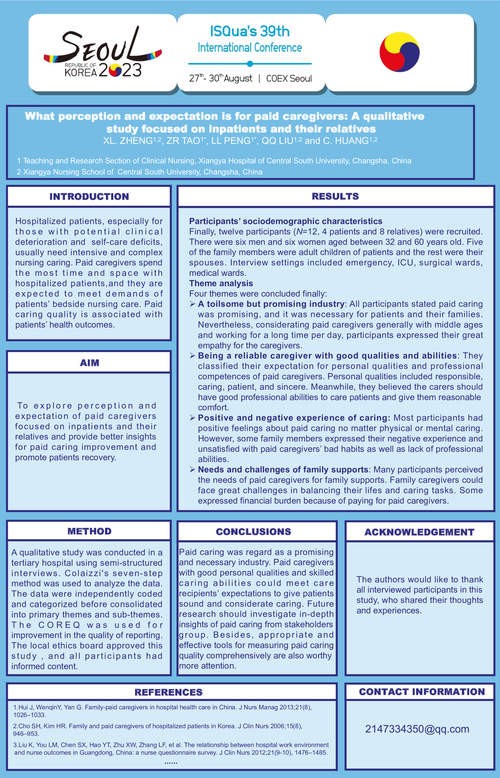
Paid caregivers spend the most time and space with hospitalized patients,and they are expected to meet demands of patients’ bedside nursing care. Paid caring quality is associated with patients’ health outcomes. This study aims to explore perception andexpectation of paid caregivers focused on inpatients and their relatives, to provide insights into for paid caring improvement and patients’ recovery.
Methods:
A qualitative study was conducted in a tertiary hospital using semi-structured interviews. Colaizzi's seven-step method was used to analyze the data. The data were independently coded and categorized before consolidated into primary themes and sub-themes. The COREQ was used for improvement in the quality of reporting. The local ethics board approved this study , and all participants had informed content.
Results:
Finally, four patients and eight relatives were included. Four themes were identified: (1)a toilsome but promising industry; (2)being a reliable caregiver with good qualities and abilities; (3)positive and negative experience of caring; (4)needs and challenges of family
supports.
Conclusion:
Paid caring was regard as a promising and necessary industry. Paid caregivers with good personal qualities and skilled caring abilities could meet care recipients’ expectations to give patients sound and considerate caring. Future research should investigate in-depth
insights of paid caring from stakeholders group. Besides, appropriate and effective tools for measuring paid caring quality comprehensively are also worthy more attention.