708 posters, 8 topics, 16 sessions, 1,190 authors, 600 institutions
ePostersLive by SciGen Technologies S.A. All rights reserved.
ISQua's 39th International Conference 2023
August 27 - 30, 2023 | Seoul, Republic of Korea

P504
A DEEP LEARNING BASED GASTRIC SECTION CORRELATION NETWORK (GSCNET) COULD HELP PREDICT THE PRESENCE OF CORPUS-PREDOMINANT GASTRITIS INDEX (CGI) FROM ENDOSCOPIC IMAGES WITHOUT BIOPSY
Poster Presenter
Part of Topic
Digital Healthcare and Innovation
A deep learning based gastric section correlation network (GSCNet) could help predict the presence of corpus-predominant gastritis index (CGI) from endoscopic images without biopsy.
Authors and affiliations
YC Tsai1,2, JY Jhang3, HB Yang4,6, CR Huang3, HC Cheng1,2,5, and BS Sheu2,5
- Department of Internal Medicine, Tainan Hospital, Ministry of Health and Welfare, Executive Yuan, Tainan, Taiwan
- Department of Internal Medicine, National Cheng Kung University Hospital, College of Medicine, National Cheng Kung University, Tainan, Taiwan
- Department of Computer Science and Engineering, National Chung Hsing University.
- Department of Pathology, National Cheng Kung University Hospital, College of Medicine, National Cheng Kung University, Tainan, Taiwan
- Institute of Clinical Medicine, National Cheng Kung University Hospital, College of Medicine, National Cheng Kung University, Tainan, Taiwan
- Department of Pathology, Ton Yen General Hospital, Hsin-Chu, Taiwan
Introduction:
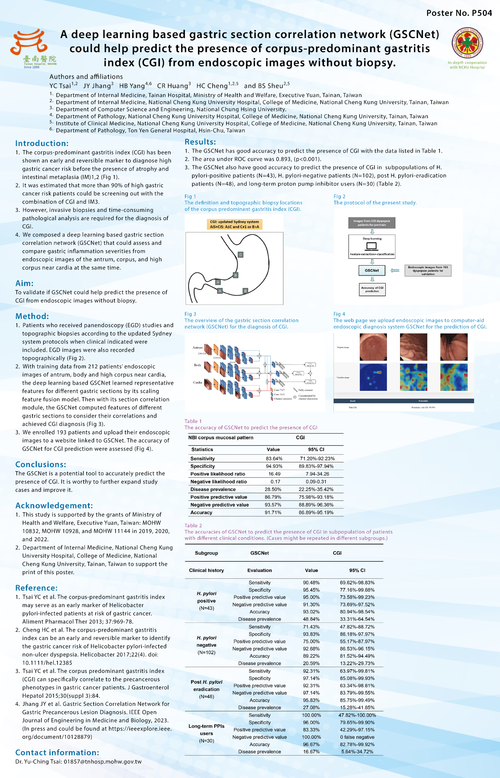
- The corpus-predominant gastritis index (CGI) has been shown an early and reversible marker to diagnose high gastric cancer risk before the presence of atrophy and intestinal metaplasia (IM)1,2 (Fig 1).
- It was estimated that more than 90% of high gastric cancer risk patients could be screening out with the combination of CGI and IM3.
- However, invasive biopsies and time-consuming pathological analysis are required for the diagnosis of CGI.
- We composed a deep learning based gastric section correlation network (GSCNet) that could assess and compare gastric inflammation severities from endoscopic images of the antrum, corpus, and high corpus near cardia at the same time.
Aim:
To validate if GSCNet could help predict the presence of CGI from endoscopic images without biopsy.
Method:
- Patients who received panendoscopy (EGD) studies and topographic biopsies according to the updated Sydney system protocols when clinical indicated were included. EGD images were also recorded topographically (Fig 2).
- With training data from 212 patients’ endoscopic images of antrum, body and high corpus near cardia, the deep learning based GSCNet learned representative features for different gastric sections by its scaling feature fusion model. Then with its section correlation module, the GSCNet computed features of different gastric sections to consider their correlations and achieved CGI diagnosis (Fig 3).
- We enrolled 193 patients and upload their endoscopic images to a website linked to GSCNet. The accuracy of GSCNet for CGI prediction were assessed (Fig 4).
Results:
- The GSCNet has good accuracy to predict the presence of CGI with the data listed in Table 1.
- The area under ROC curve was 0.893, (p<0.001).
- The GSCNet also have good accuracy to predict the presence of CGI in subpopulations of H. pylori-positive patients (N=43), H. pylori-negative patients (N=102), post H. pylori-eradication patients (N=48), and long-term proton pump inhibitor users (N=30) (Table 2).
Conclusions:
The GSCNet is a potential tool to accurately predict the presence of CGI. It is worthy to further expand study cases and improve it.
Acknowledgement:
- This study is supported by the grants of Ministry of Health and Welfare, Executive Yuan, Taiwan: MOHW 10832, MOHW 10928, and MOHW 11144 in 2019, 2020, and 2022.
- Department of Internal Medicine, National Cheng Kung University Hospital, College of Medicine, National Cheng Kung University, Tainan, Taiwan to support the print of this poster.
Reference:
- Tsai YC et al. The corpus-predominant gastritis index may serve as an early marker of Helicobacter pylori-infected patients at risk of gastric cancer. Aliment Pharmacol Ther 2013; 37:969-78.
- Cheng HC et al. The corpus-predominant gastritis index can be an early and reversible marker to identify the gastric cancer risk of Helicobacter pylori-infected non-ulcer dyspepsia. Helicobacter 2017;22(4). doi: 10.1111/hel.12385
- Tsai YC et al. The corpus predominant gastritis index (CGI) can specifically correlate to the precancerous phenotypes in gastric cancer patients. J Gastroenterol Hepatol 2015;30(suppl 3):84.
- Jhang JY et al. Gastric Section Correlation Network for Gastric Precancerous Lesion Diagnosis. IEEE Open Journal of Engineering in Medicine and Biology, 2023. (In press and could be found at https://ieeexplore.ieee.org/document/10128879)