708 posters, 8 topics, 16 sessions, 1,190 authors, 600 institutions
ePostersLive by SciGen Technologies S.A. All rights reserved.
ISQua's 39th International Conference 2023
August 27 - 30, 2023 | Seoul, Republic of Korea

ISQUA2023-ABS-2348
THE IMPACT OF CONTINUOUS QUALITY IMPROVEMENT ON SLEEP DISTORTION IN CRITICAL PATIENTS
Poster Presenter
Authors
Affiliations
Part of Topic
Patient Safety & Quality Improvement
THE IMPACT OF CONTINUOUS QUALITY IMPROVEMENT ON SLEEP DISTORTION IN CRITICAL PATIENTS
Ping-Teng Chu1, Ya-Meei Lue1, Hsing-Chi Chung1, Sheng-Huei Huang1, Ming-Shiuan Huang1, Wang-Chuan Juang1,
Wei-Chun Huang* 1
1Kaohsiung Veterans General Hospital, Kaohsiung, Taiwan
Introduction: Intensive care unit (ICU) patients were shown to have poor quality of sleep over the last three decades.
However, to improve the sleep distortion in critical patients remains challenging. The aim of this study is to investigate the
impact of continuous quality improvement on sleep distortion in critical patients in critical patients.
Methods: All consecutive patients form 2019-2021 in 6 adult ICUs were enrolled. The key interventions include novel
sacral suspended decompression recumbent care, simple air pressure turning device, remote warning care system and
using big data to monitor critical care warning indicators. The patients were divided into three periods: pre-intervention
period from Jan to Dec 2019, intervention period from Jan to Dec 2020, and post-intervention period from Jan to Dec
2021.
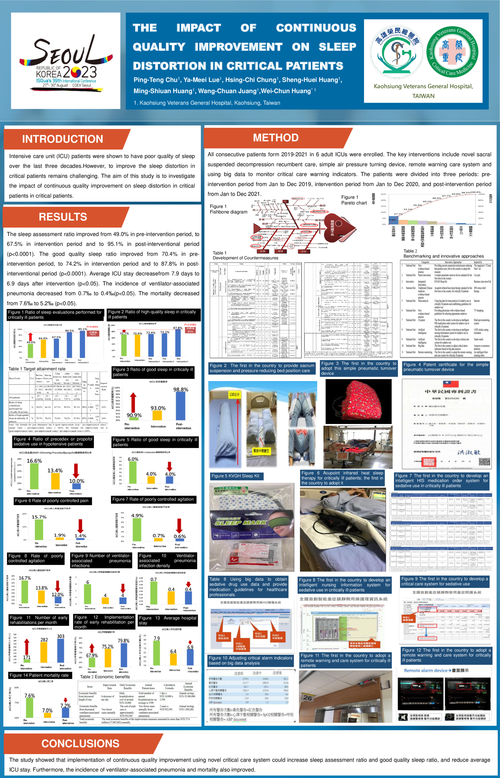
Results: The sleep assessment ratio improved from 49.0% in pre-intervention period, to 67.5% in intervention period and
to 95.1% in post-interventional period (p<0.0001). The good quality sleep ratio improved from 70.4% in pre-intervention
period, to 74.2% in intervention period and to 87.8% in post-interventional period (p<0.0001). Average ICU stay decrease
from 7.9 days to 6.9 days after intervention (p<0.05). The incidence of ventilator-associated pneumonia decreased from
0.7‰ to 0.4‰(p<0.05). The mortality decreased from 7.6‰ to 5.2‰ (p<0.05).
Conclusion: The study showed that implementation of continuous quality improvement using novel critical care system
could increase sleep assessment ratio and good quality sleep ratio, and reduce average ICU stay. Furthermore, the
incidence of ventilator-associated pneumonia and mortality also improved.