708 posters, 8 topics, 16 sessions, 1,190 authors, 600 institutions
ePostersLive by SciGen Technologies S.A. All rights reserved.
ISQua's 39th International Conference 2023
August 27 - 30, 2023 | Seoul, Republic of Korea

P484
SOCIAL FACTORS INFLUENCING THE ADOPTION OF DASHBOARDS TO IMPROVE THE QUALITY OF CARE
Poster Presenter
Authors
Affiliations
Part of Topic
Digital Healthcare and Innovation
Social factors influencing the adoption of dashboards to improve quality of care
Introduction:
Increasing number of dashboards are designed for quality improvement in healthcare1.
Previous research on dashboarding:
Technical requirements:
Design requirements:
Dashboards are no magic bullets that automatically improve quality of care.
Research question: which social factors within the team influence the adoption of dashboards in practice and how do these factors interrelate?
Methods:
An embedded case study was performed evaluating the development and implementation of two disease-specific dashboards in an average size regional hospital in the Netherlands.
The study consisted of:
The domains of the NASSS framework5 served as a coding scheme for thematic analysis of the data.
Results:
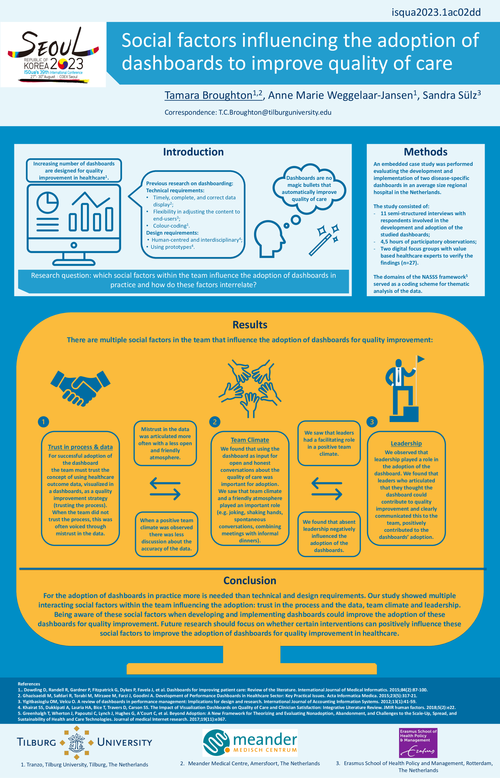
There are multiple social factors in the team that influence the adoption of dashboards for quality improvement:
1. Trust in process & data
For successful adoption of the dashboard the team must trust the concept of using healthcare outcome data, visualized in a dashboards, as a quality improvement strategy (trusting the process). When the team did not trust the process, this was often voiced through mistrust in the data.
- Mistrust in the data was articulated more often with a less open and friendly atmosphere.
- When a positive team climate was observed there was less discussion about the accuracy of the data.
2. Team Climate
We found that using the dashboard as input for open and honest conversations about the quality of care was important for adoption. We saw that team climate and a friendly atmosphere played an important role (e.g. joking, shaking hands, spontaneous conversations, combining meetings with informal dinners).
- We saw that leaders had a facilitating role in a positive team climate.
- We found that absent leadership negatively influenced the adoption of the dashboards.
3. Leadership
We observed that leadership played a role in the adoption of the dashboard. We found that leaders who articulated that they thought the dashboard could contribute to quality improvement and clearly communicated this to the team, positively contributed to the dashboards’ adoption.
Conclusion:
For the adoption of dashboards in practice more is needed than technical and design requirements. Our study showed multiple interacting social factors within the team influencing the adoption: trust in the process and the data, team climate and leadership. Being aware of these social factors when developing and implementing dashboards could improve the adoption of these dashboards for quality improvement. Future research should focus on whether certain interventions can positively influence these social factors to improve the adoption of dashboards for quality improvement in healthcare.