708 posters, 8 topics, 16 sessions, 1,190 authors, 600 institutions
ePostersLive by SciGen Technologies S.A. All rights reserved.
ISQua's 39th International Conference 2023
August 27 - 30, 2023 | Seoul, Republic of Korea

P483
SMART GLASSES IN SURGERY : THE THEATRE AND BEYOND
Poster Presenter
Authors
Syama Gollapalli, Vidushi Sharma, Adel Al Ghazwi, Leonie Heskin
Affiliations
Part of Topic
Digital Healthcare and Innovation
Smart Glasses in Surgery: The Theatre and Beyond
Dr. S.Gollapalli 1, Dr. A. AlGhazwi 2 , Ms. L. Heskin 3
1 Royal College of Surgeons, Ireland, Clinical Lecturer, Department of Surgery 2 Royal College of Surgeons, Ireland, Clinical Lecturer, Department of Surgery
3 Royal College of Surgeons, Ireland, Simulation technology development lead.
isqua2023.1ab02db
|
INTRODUCTION |
|||||
|
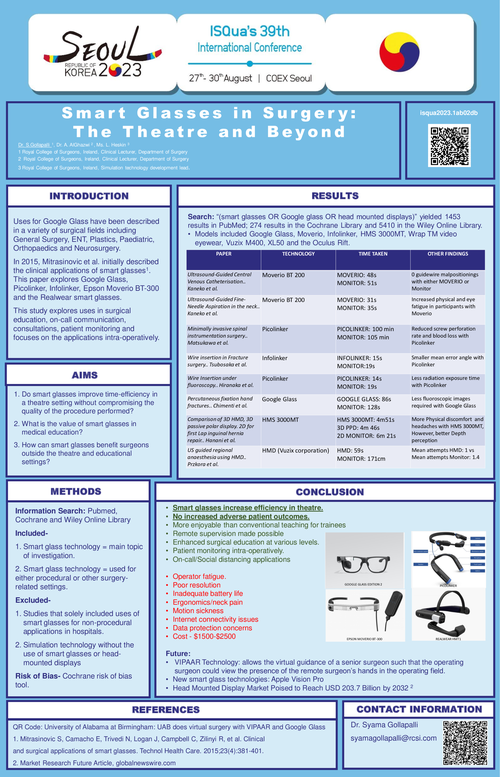
Uses for Google Glass have been described in a variety of surgical fields including General Surgery, ENT, Plastics, Paediatric, Orthopaedics and Neurosurgery. In 2015, Mitrasinovic et al. initially described the clinical applications of smart glasses1. This paper explores Google Glass, Picolinker, Infolinker, Epson Moverio BT-300 and the Realwear smart glasses. This study explores uses in surgical education, on-call communication, consultations, patient monitoring and focuses on the applications intra-operatively. |
|||||
|
Search: “(smart glasses OR Google glass OR head mounted displays)” yielded 1453 results in PubMed; 274 results in the Cochrane Library and 5410 in the Wiley Online Library. • Models included Google Glass, Moverio, Infolinker, HMS 3000MT, Wrap TM video
eyewear, Vuzix M400, XL50 and the Oculus Rift.
|
PAPER |
TECHNOLOGY |
TIME TAKEN |
OTHER FINDINGS |
|
Ultrasound-Guided Central Venous Catheterisation.. Kaneko et al. |
Moverio BT 200 |
MOVERIO: 48s MONITOR: 51s |
0 guidewire malpositionings with either MOVERIO or Monitor |
|
Ultrasound-Guided Fine- Needle Aspiration in the neck.. Kaneko et al. |
Moverio BT 200 |
MOVERIO: 31s MONITOR: 35s |
Increased physical and eye fatigue in participants with Moverio |
|
Minimally invasive spinal instrumentation surgery.. Matsukawa et al. |
Picolinker |
PICOLINKER: 100 min MONITOR: 105 min |
Reduced screw perforation rate and blood loss with Picolinker |
|
Wire insertion in Fracture surgery.. Tsubosaka et al. |
Infolinker |
INFOLINKER: 15s MONITOR:19s |
Smaller mean error angle with Picolinker |
|
Wire Insertion under fluoroscopy.. Hiranaka et al. |
Picolinker |
PICOLINKER: 14s MONITOR: 19s |
Less radiation exposure time with Picolinker |
|
Percutaneous fixation hand fractures.. Chimenti et al. |
Google Glass |
GOOGLE GLASS: 86s MONITOR: 128s |
Less fluoroscopic images required with Google Glass |
|
Comparison of 3D HMD, 3D passive polar display. 2D for first Lap inguinal hernia repair.. Hanani et al. |
HMS 3000MT |
HMS 3000MT: 4m51s 3D PPD: 4m 46s |
More Physical discomfort and headaches with HMS 3000MT, However, better Depth perception |
|
US guided regional anaesthesia using HMD.. Przkora et al. |
HMD (Vuzix corporation) |
HMD: 59s MONITOR: 171cm |
Mean attempts HMD: 1 vs Mean attempts Monitor: 1.4 |
• Smartglassesincreaseefficiencyintheatre.
• Noincreasedadversepatientoutcomes.
• Moreenjoyablethanconventionalteachingfortrainees• Remotesupervisionmadepossible
• Enhancedsurgicaleducationatvariouslevels.
• Patientmonitoringintra-operatively.
• On-call/Socialdistancingapplications
• Operatorfatigue.
• Poorresolution
• Inadequatebatterylife
• Ergonomics/neckpain
• Motionsickness
• Internetconnectivityissues • Dataprotectionconcerns
• Cost-$1500-$2500
Future:
GOOGLE GLASS EDITION 2
EPSON MOVERIO BT-300
PICOLINKER
REALWEAR HMT1
•
• •
VIPAAR Technology: allows the virtual guidance of a senior surgeon such that the operating
surgeon could view the presence of the remote surgeon’s hands in the operating field.Newsmartglasstechnologies:AppleVisionPro
HeadMountedDisplayMarketPoisedtoReachUSD203.7Billionby2032
2
QR Code: University of Alabama at Birmingham: UAB does virtual surgery with VIPAAR and Google Glass 1. Mitrasinovic S, Camacho E, Trivedi N, Logan J, Campbell C, Zilinyi R, et al. Clinical
and surgical applications of smart glasses. Technol Health Care. 2015;23(4):381-401.
2. Market Research Future Article, globalnewswire.com