708 posters, 8 topics, 16 sessions, 1,190 authors, 600 institutions
ePostersLive by SciGen Technologies S.A. All rights reserved.
ISQua's 39th International Conference 2023
August 27 - 30, 2023 | Seoul, Republic of Korea

P471
DEVELOPMENT AND USER-TESTING OF DECISION AIDS FOR PATIENTS FOR THE SELF-MANAGEMENT OF FOUR CHRONIC CONDITIONS
Poster Presenter
Authors
Rosa Sunol, Claudia Valli, Jessica Beltran, Ena Nino de Guzman, Marta Ballester, Carola Orrego, Monique Heijmans, Oliver Groene, Pablo Alonso-Coello
Affiliations
AVEDIS DONABEDIAN RESEARCH INTITUTE, Avedis Donabedian Research Institute (FAD), Barcelona, Spain, Iberoamerican Cochrane Centre - Biomedical Research Institute Sant Pau (IIB Sant Pau), Barcelona, Spain, Netherlands Institute for Health Services Research (Nivel), Utrecht, The Netherlands, OptiMedis AG, Hamburg, Germany
Part of Topic
Digital Healthcare and Innovation
Development and user-testing of decision aids for patients for the self-management of four chronic conditions
P471
Introduction:
Decision aids (DA) are tools that enable patients to compare several treatment options and make informed choices. These tools include information on the available treatment options, evidence about their benefits and risks with related certainty, as well as practical considerations about the interventions being considered.
Objective:
To develop an interactive web-based DA for patients with one of four chronic conditions (type 2 diabetes mellitus, obesity, heart failure and chronic obstructive pulmonary disease) making decisions about self-management interventions.
Methods:
We followed a systematic iterative mixed methods process including:
1) Scoping and design,
2) Development of a mock-up and prototype,
3) User-testing with patients and clinicians.
The first two steps were overseen by a multidisciplinary research team including patients, clinicians, methodologists, and other relevant stakeholders. For the user-testing, we recruited a purposive sample of patients and health professionals until data saturation and conducted semi-structured interviews. We performed content analysis of the interviews and used participants feedback to improve the DA tools.
Results:
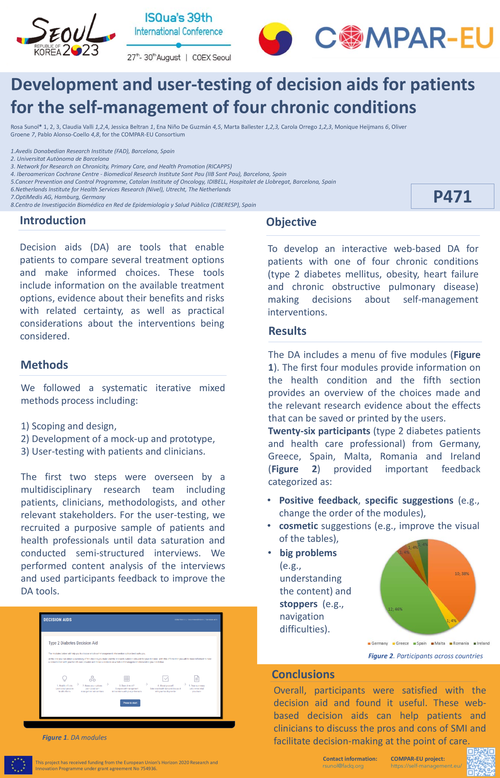
The DA includes a menu of five modules (Figure 1). The first four modules provide information on the health condition and the fifth section provides an overview of the choices made and the relevant research evidence about the effects that can be saved or printed by the users.
Twenty-six participants (type 2 diabetes patients and health care professional) from Germany, Greece, Spain, Malta, Romania and Ireland (Figure 2) provided important feedback categorized as:
Conclusions:
Overall, participants were satisfied with the decision aid and found it useful. These web-based decision aids can help patients and clinicians to discuss the pros and cons of SMI and facilitate decision-making at the point of care.