708 posters, 8 topics, 16 sessions, 1,190 authors, 600 institutions
ePostersLive by SciGen Technologies S.A. All rights reserved.
ISQua's 39th International Conference 2023
August 27 - 30, 2023 | Seoul, Republic of Korea

P470
AIR QUALITY MONITORING IN ISOLATION ROOMS THROUGH DIGITAL SOFTWARE AND MICROBIOLOGY EXAMINATION
Poster Presenter
Part of Topic
Digital Healthcare and Innovation
Ridha Wahyutomo1,2, Ary Dwi Jatmiko1,3
1 Doctoral Program In Digital Architecture, Soegijapranata Catholic University Semarang
2 Clinical Microbiology, Mardi Rahayu Hospital Kudus
3 Faculty Of Architecture, Widya Kartika University Surabaya
INTRODUCTION
The pandemic has had a widespread impact on various sectors of life, especially the health sector, especially related to the provision of service facilities including the design of isolation rooms to reduce the risk of infection. The design of isolation room is emphasized on the arrangement of air space with the aim of obtaining air quality with minimal numbers of microorganisms and having a safe air flow.
AIM
Overall, the purpose of this study is to obtain an overview of the airflow of the four designs of isolation rooms and an overview of the number of microorganisms that appear as a consequence of the air layout design.
METHOD
This study is an observational descriptive study. The study samples were air in the isolation rooms of four hospitals in Central Java. The data observed in the study include the size of the room, the location of ventilation, exhaust fans, temperature, humidity, air flow, and the number of airborne microorganisms using primary data from the assessment and surveillance of isolation rooms. The overall physical data of the building was processed using digital CFD (computational Fluid Dynamic) software which was reviewed with the results of airborne microorganism culture.
RESULTS
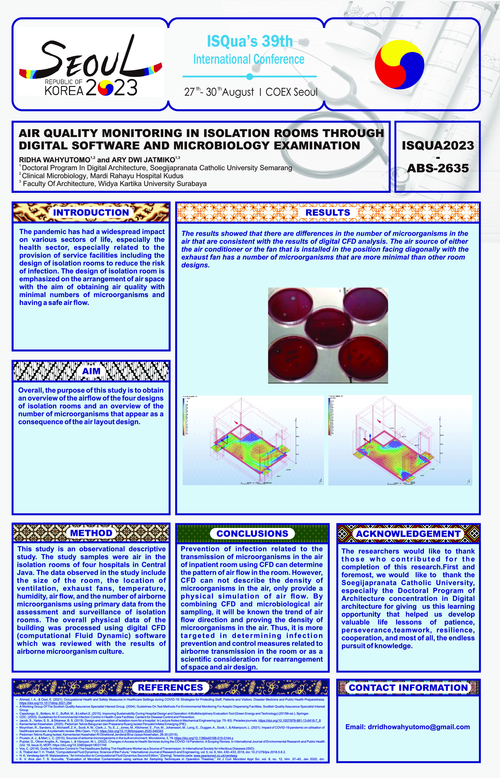
The results showed that there are differences in the number of microorganisms in the air that are consistent with the results of digital CFD analysis. The air source of either the air conditioner or the fan that is installed in the position facing diagonally with the exhaust fan has a number of microorganisms that are more minimal than other room designs.
CONCLUSIONS
Prevention of infection related to the transmission of microorganisms in the air of inpatient room using CFD can determine the pattern of air flow in the room. However, CFD can not describe the density of microorganisms in the air, only provide a physical simulation of air flow. By combining CFD and microbiological air sampling, it will be known the trend of air flow direction and proving the density of microorganisms in the air. Thus, it is more targeted in determining infection prevention and control measures related to airborne transmission in the room or as a scientific consideration for rearrangement of space and air design.
ACKNOWLEDGEMENT
The researchers would like to thank those who contributed for the completion of this research. First and foremost, we would like to thank the Soegijapranata Catholic University, especially the Doctoral Program of Architecture concentration in Digital architecture for giving us this learning opportunity that helped us develop valuable life lessons of patience, perseverance, teamwork, resilience, cooperation, and most of all, the endless pursuit of knowledge.
REFERENCES
Ahmad, I A. & Co E (2021) Occupational Health and Safety Measures in Healthcare Settings during COVID-19 Strategies for Protecting Staff, Patients and Visitors Disaster Medicine and Public Health Preparedness. https://doi.org/10.1017/dmp 2021.294
A Working Group Of The Scottish Quality Assurance Specialist Interest Group. (2004). Guidelines On Test Methods For Environmental Monitoring For Aseptic Dispensing Facilities. Scottish Quality Assurance Specialist Interest Group
Capolongo, S. Bottero M. C., Buffoli, M., & Lettieri E (2015) Improving Sustainability During Hospital Design and Operation: A Multidisciplinary Evaluation Tool (Green Energy and Technology) (2015th ed.). Springer.
CDC (2003) Guidelines for Environmental Infection Control in Health-Care Facilities Centers for Disease Control and Prevention.
Jacob S. Yadav, 5.S.& Skanwar B. S. (2019) Design and simulation of isolation room for a hospital. In Lecture Notes in Mechanical Engineering (pp. 75-93) Pleiades joumals https://doi.org/10.1007/978-981-13-6416-7-8.
Kementerian Kesehatan (2020) Pedoman Teknis Bangunan dan Prasarana Ruang (solasi Penyakit Infeksi Emerging (PIE).
Moynihan, R. Sanders, S. Michaleff, 2 A, Scott, A M. Clark, J. To, E. J., Jones, M., Kitchener, E., Fox M. Johansson, M. Lang, E Duggan, A. Scott, 1., & Albargouni, L. (2021). Impact of COVID-19 pandemic on utilisation of healthcare services: A systematic review BMJ Open, 11(3). https://doi.org/10.1136/bmjopen 2020-045343
Pedoman Teknis Ruang Isolasi, Kementerian Kesehatan RI Direktorat Jenderal Bina Upaya Kesehatan, 28-30 (2015).
Prussin, AJ, & Marr LC (2015) Sources of airbome microorganisms in the built environment. Microbiome, 3, 78 https://doi.org/10.1186/140168-015-0144-z
Pujolar, G. Oliver Angles A. Vargas. & Vazquez. M.L. (2022) Changes in Access to Health Services during the COVID-19 Pandemic: A Scoping Review In intemational Journal of Environmental Research and Public Health (Vol 19, Issue 3) MOPL https://doi.org/10.3390/jerph19031749
Vos, C. (2018) Guide To Infection Control in The Healthcare Setting The Healthcare Worker as a Source of Transmission. In international Society for Infectious Diseases (SID)
S Thabet dan T. H. Thabit, Computational Fluid Dynamics: Science of the Future," International Journal of Research and Engineering, vol. 5, no. 6, hlm. 430-433, 2018, doi: 10.21276/jre 2018.5.6.2
H.K. Versteeg dan W. Malalasekera, "An Introduction to Computational Fluid Dynamics Second Edition [Daring] Tersedia pada: www.pearsoned.co.uk/versteer
K. V. Alva dan T. S. Kunvilla, Evaluation of Microbial Contamination using various Air Sampling Techniques in Operation Theatres, Int J Curr Microbial Appl Sci, vol. 9, no. 12. him 37-45, Jan 2020.
CONTACT INFORMATION
drridhowahyutomo@gmail.com