708 posters, 8 topics, 16 sessions, 1,190 authors, 600 institutions
ePostersLive by SciGen Technologies S.A. All rights reserved.
ISQua's 39th International Conference 2023
August 27 - 30, 2023 | Seoul, Republic of Korea

ISQUA2023-ABS-2084
VALUE-DRIVEN GENERALIST CARE PERFORMANCE FRAMEWORK FOR PEOPLE WITH MULTIMORBIDITY
Poster Presenter
Authors
Affiliations
Part of Topic
External Evaluation
Singapore faces challenges due to an aging population and complex healthcare needs, resulting in increasing costs and an unsustainable future. Healthcare spending has risen from 4.47% of GDP in 2016 to 5.9% in 2020, projected to reach 9% by 2029.[1] To tackle this, a comprehensive approach is needed to coordinate care for individuals with multiple medical conditions.
Multimorbidity is increasingly common and poses challenges for the healthcare system.[2] It is commonly defined as having more than 2 chronic conditions from a list of 20 CDMP chronic conditions.[4,5] It is associated with challenges such as functional decline, reduced quality of life, polypharmacy, mental health difficulties, and an increased rate of admission.[3] The burden of multimorbidity is enhanced in the inpatient setting with the need for more diagnostic tests and investigations, and a longer length of stay.[4] The healthcare cost of a person with 2 chronic conditions can more than double that of a person with a single condition.[5] Individuals who have multimorbidity are associated with poorer outcomes and increased hospitalizations, as well as highly fragmented care due to multispecialty care.[6,7]
People with multimorbidity face significant social issues which compound and perpetuate challenges, hindering better health outcomes. Healthcare providers recognize these challenges, but conventional care and services provision does not sufficiently optimize outcomes from the perspective of the patient, for example, through Patient Reported Outcome Measures or using a Patient Value Compass; and most healthcare/hospital performance frameworks are not designed to measure and driven performance management for population health outcomes and value.
VDC programs and VDPM focus on people's outcomes and improving them cost-effectively. They go beyond clinical outcomes to consider functional and care experience outcomes, prevention, right-siting, and care integration for better outcomes at lower costs.
With an aging population, a VDGC approach can balance treatment burden and patient preferences. Specialists can reduce unnecessary resource consumption like diagnostic scans. Shifting to VDGC for multi-morbidity can deliver cost-effective care.
By standardizing performance measurement of care for people with multi-morbidity, VDPM enables re-orientation and redesign of healthcare provision, transforming our system into a value-driven population health system.
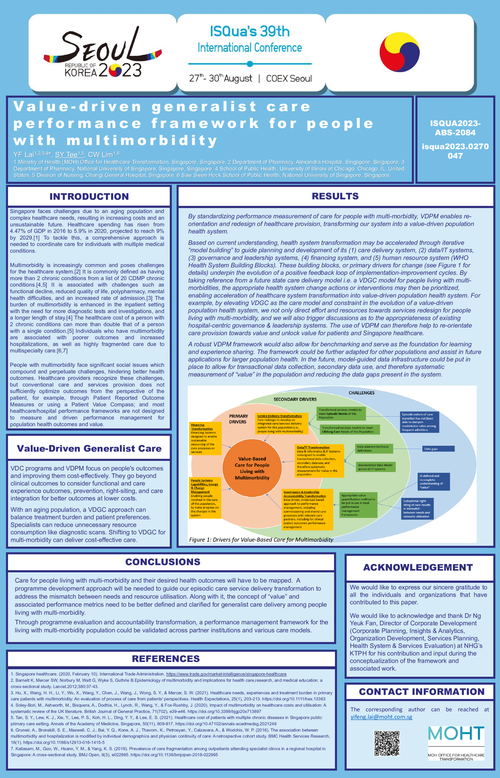
Based on current understanding, health system transformation may be accelerated through iterative “model building” to guide planning and development of its (1) care delivery system, (2) data/IT systems, (3) governance and leadership systems, (4) financing system, and (5) human resource system (WHO Health System Building Blocks). These building blocks, or primary drivers for change (see Figure 1 for details) underpin the evolution of a positive feedback loop of implementation-improvement cycles. By taking reference from a future state care delivery model i.e. a VDGC model for people living with multi-morbidities, the appropriate health system change actions or interventions may then be prioritized, enabling acceleration of healthcare system transformation into value-driven population health system. For example, by elevating VDGC as the care model and constraint in the evolution of a value-driven population health system, we not only direct effort and resources towards services redesign for people living with multi-morbidity, and we will also trigger discussions as to the appropriateness of existing hospital-centric governance & leadership systems. The use of VDPM can therefore help to re-orientate care provision towards value and unlock value for patients and Singapore healthcare.
A robust VDPM framework would also allow for benchmarking and serve as the foundation for learning and experience sharing. The framework could be further adapted for other populations and assist in future applications for larger population health. In the future, model-guided data infrastructure could be put in place to allow for transactional data collection, secondary data use, and therefore systematic measurement of “value” in the population and reducing the data gaps present in the system.
Care for people living with multi-morbidity and their desired health outcomes will have to be mapped. A programme development approach will be needed to guide our episodic care service delivery transformation to address the mismatch between needs and resource utilisation. Along with it, the concept of “value” and associated performance metrics need to be better defined and clarified for generalist care delivery among people living with multi-morbidity.
Through programme evaluation and accountability transformation, a performance management framework for the living with multi-morbidity population could be validated across partner institutions and various care models.