708 posters, 8 topics, 16 sessions, 1,190 authors, 600 institutions
ePostersLive by SciGen Technologies S.A. All rights reserved.
ISQua's 39th International Conference 2023
August 27 - 30, 2023 | Seoul, Republic of Korea

ISQUA2023-ABS-2479
CAN ADVANCED ANALYSIS INCREASE THE IMPACT OF PATIENT EVALUATIONS OF GENERAL PRACTICE? INSIGHTS FROM THE EUROPEP SURVEY DATA MODELLING PROJECT
Part of Topic
External Evaluation
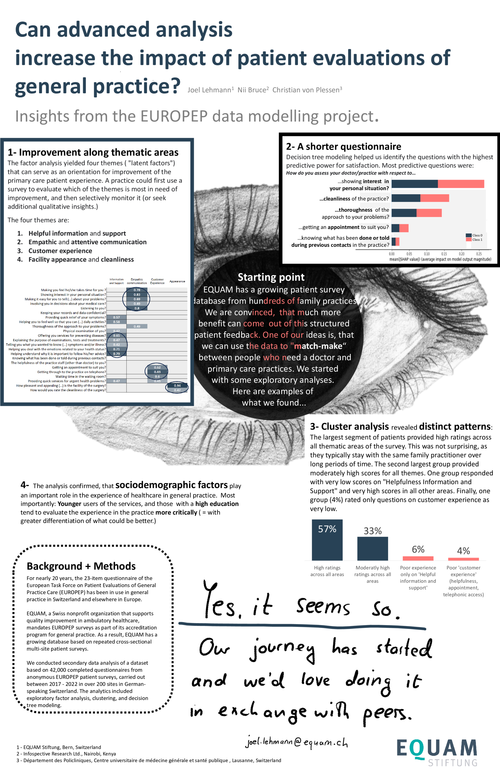
For nearly 20 years, the 23-item PREMS questionnaire of the European Task Force on Patient Evaluations of General Practice Care (EUROPEP) has been in use in general practice in Switzerland and elsewhere in Europe. EQUAM, a Swiss nonprofit organization that supports quality improvement in ambulatory healthcare, mandates EUROPEP surveys as part of its accreditation program for general practice. As a result, EQUAM has a growing database based on repeated cross-sectional multi-site patient surveys.
We conducted secondary data analysis of a dataset based on 42,000 completed questionnaires from anonymous EUROPEP patient surveys, carried out between 2017 - 2022 in over 200 sites in German-speaking Switzerland. The analytics included exploratory factor analysis, clustering, and decision tree modeling.
Improvement along thematic areas
The factor analysis yielded four themes ( "latent factors") that can serve as an orientation for improvement of the primary care patient experience. A practice could first use a survey to evaluate, which of the themes are most in need of improvement, and then selectively improve and monitor (or seek additional qualitative insights.)
The four themes are:
1. Helpful information and support
2. Empathic and attentive communication
3. Customer experience
4. Facility appearance and cleanliness
A shorter questionnaire
Decision tree modeling helped us identify the questions with the highest predictive power for patient satisfaction.
Cluster analysis revealed four distinct patterns
The largest segment of patients provided high ratings across all thematic areas of the survey. This was not surprising, as they typically stay with the same family practitioner over long periods of time. The second largest group provided moderately high scores for all themes. One group responded with very low scores on "Helpfulness Information and Support" and very high scores in all other areas. Finally, one group (4%) rated only questions on customer experience as very low.