708 posters, 8 topics, 16 sessions, 1,190 authors, 600 institutions
ePostersLive by SciGen Technologies S.A. All rights reserved.
ISQua's 39th International Conference 2023
August 27 - 30, 2023 | Seoul, Republic of Korea

P366
THE BEST PRACTICES FOR VIRTUAL SURVEY
Poster Presenter
Part of Topic
External Evaluation
INTRODUCTION
The National Accreditation Organization (ONA) is responsible for developing and managing Brazilian health quality and safety standards. ONA develop quality and safety standards for the accreditation of organizations providing healthcare services in all Brazil. The Brazilian National Accreditation System (SBA/ONA) is independent, private, constituted in a representative way by members that form the various social segments related to health, civil society, and the Brazilian health system (public and private sectors). It is also made up of a set of structures, processes, and institutions whose purpose is to make the accreditation process viable in Brazil.
RESULTS
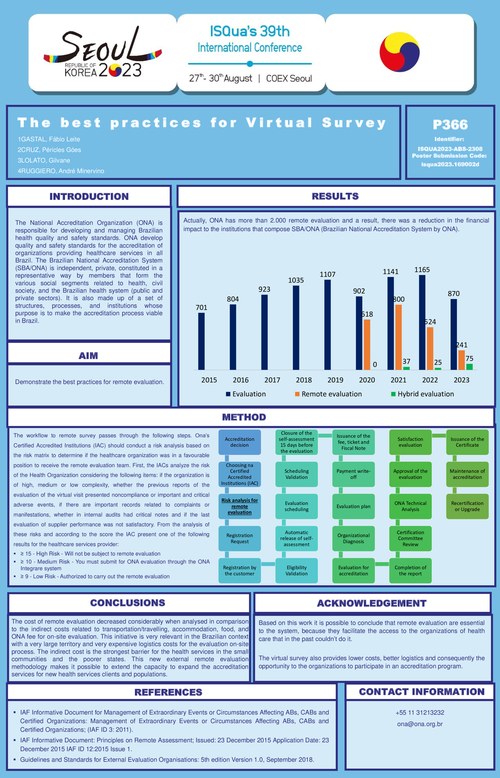
Actually, ONA has more than 2.000 remote evaluation and a result, there was a reduction in the financial impact to the institutions that compose SBA/ONA (Brazilian National Accreditation System by ONA).
AIM
Demonstrate the best practices for remote evaluation.
METHOD
The workflow to remote survey passes through the following steps. Ona’s Certified Accredited Institutions (IAC) should conduct a risk analysis based on the risk matrix to determine if the healthcare organization was in a favourable position to receive the remote evaluation team. First, the IACs analyze the risk of the Health Organization considering the following items: if the organization is of high, medium or low complexity, whether the previous reports of the evaluation of the virtual visit presented noncompliance or important and critical adverse events, if there are important records related to complaints or manifestations, whether in internal audits had critical notes and if the last evaluation of supplier performance was not satisfactory. From the analysis of these risks and according to the score the IAC present one of the following results for the healthcare services provider:
CONCLUSIONS
The cost of remote evaluation decreased considerably when analysed in comparison to the indirect costs related to transportation/travelling, accommodation, food, and ONA fee for on-site evaluation. This initiative is very relevant in the Brazilian context with a very large territory and very expensive logistics costs for the evaluation on-site process. The indirect cost is the strongest barrier for the health services in the small communities and the poorer states. This new external remote evaluation methodology makes it possible to extend the capacity to expand the accreditation services for new health services clients and populations.
ACKNOWLEDGEMENT
Based on this work it is possible to conclude that remote evaluation are essential to the system, because they facilitate the access to the organizations of health care that in the past couldn’t do it.
The virtual survey also provides lower costs, better logistics and consequently the opportunity to the organizations to participate in an accreditation program.