708 posters, 8 topics, 16 sessions, 1,190 authors, 600 institutions
ePostersLive by SciGen Technologies S.A. All rights reserved.
ISQua's 39th International Conference 2023
August 27 - 30, 2023 | Seoul, Republic of Korea

P353
EVALUATION OF INDOOR AIR QUALITY IN THE PEDIATRIC INTENSIVE CARE UNIT OF A MEDICAL CENTER IN THE GREATER TAIPEI AREA
Poster Presenter
Authors
Affiliations
Part of Topic
Universal Health Coverage and Equity
INTRODUCTION:
The European Centre for Disease Prevention and Control(ECDC) conducted infection in children epidemic servery in hospitals from 2011 to 2012, the infection epidemic in Pediatric Intensive Care Unit(PICU) was the highest. Research on the causes of infection in PICU could improve the quality of care effectively.
METHOD:
This research used Purposive Sampling method and selected a PICU in a medical center in Great Taipei area. In January and April of 2018, which were in winter and spring, the researchers monitored the indoor air quality, including carbon dioxide (CO2 ), carbon monoxide (CO), total volatile organic matter (TVOC), formaldehyde (HCHO), ozone (O3 ), aerosol PM₂.₅, PM10, and the concentration of Bioaerosols, also the temperature and humidity. By referring above information, explored the correlation between "different ward types", "different time periods" and "environmental factors" on indoor air quality.
RESULTS:
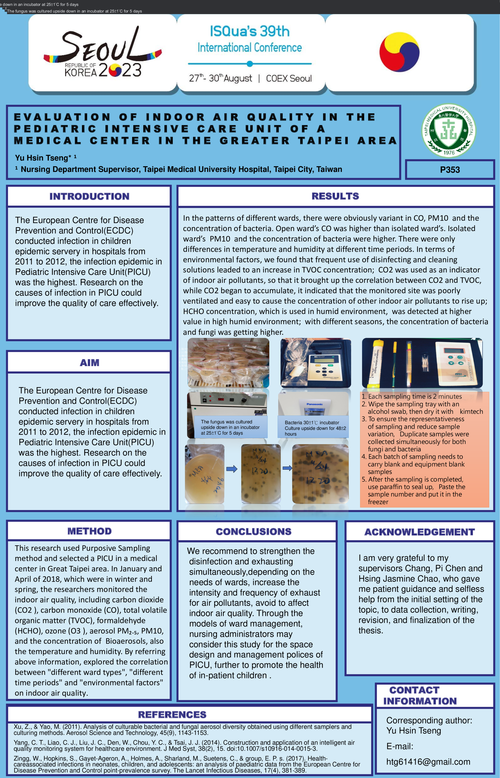
In the patterns of different wards, there were obviously variant in CO, PM10 and the concentration of bacteria. Open ward’s CO was higher than isolated ward’s. Isolated ward’s PM10 and the concentration of bacteria were higher. There were only differences in temperature and humidity at different time periods. In terms of environmental factors, we found that frequent use of disinfecting and cleaning solutions leaded to an increase in TVOC concentration; CO2 was used as an indicator of indoor air pollutants, so that it brought up the correlation between CO2 and TVOC, while CO2 began to accumulate, it indicated that the monitored site was poorly ventilated and easy to cause the concentration of other indoor air pollutants to rise up; HCHO concentration, which is used in humid environment, was detected at higher value in high humid environment; with different seasons, the concentration of bacteria and fungi was getting higher.
CONCLUSIONS:
We recommend to strengthen the disinfection and exhausting simultaneously,depending on the needs of wards, increase the intensity and frequency of exhaust for air pollutants, avoid to affect indoor air quality. Through the models of ward management, nursing administrators may consider this study for the space design and management polices of PICU, further to promote the health of in-patient children .