708 posters, 8 topics, 16 sessions, 1,190 authors, 600 institutions
ePostersLive by SciGen Technologies S.A. All rights reserved.
ISQua's 39th International Conference 2023
August 27 - 30, 2023 | Seoul, Republic of Korea

P328
EQUAL AND QUALITY HEALTHCARE SERVICE FOR REFUGEES AND MIGRANTS
Poster Presenter
Authors
Didem INCEGIL, İbrahim Halil Kayral, Elif Ozyurt, Figen Çizmeci Şenel
Affiliations
Part of Topic
Universal Health Coverage and Equity
EQUAL AND QUALITY HEALTHCARE SERVICE FOR REFUGEES AND MIGRANTS
Didem İncegil, İbrahim Halil Kayral, Ceren Can, Elif Özyurt, Figen Çizmeci Şenel
Introduction:
According to 2022 data, there are approximately one billion immigrants worldwide today, and approximately one in eight people fit this definition. In the report which published by WHO in 2022-World Report On The Health Of Refugees And Migrants- worldwide, millions of refugees and migrants in vulnerable situations, such as low-skilled migrant workers, face worse health outcomes, particularly from places where living and working conditions are substandard. This eliminates possibility of achieving sustainable development goals. There is also urgent need to address root causes of poor health and radically reorient health systems to respond to an increasingly mobile world. Urgent collaborations and investments are needed for quality and improvement of health services for refugees and migrants.
Methods:
Undoubtedly, one of the most affected countries in migrant and refugee wave is Türkiye. The number of Syrians, who started their forced mass migration to Türkiye in 2011, reached today in twelve years; from security to future of urban areas, settlement, housing, education, health, labor force participation, language problem, communication, housing and cohesion policies, it has revealed need to develop serious public policies. In this study, examples will be given about health policies and measures taken to ensure that immigrants and refugees in Türkiye can receive quality health services, and also, what needs to be done in order to receive equal and quality health care is discussed.
Results:
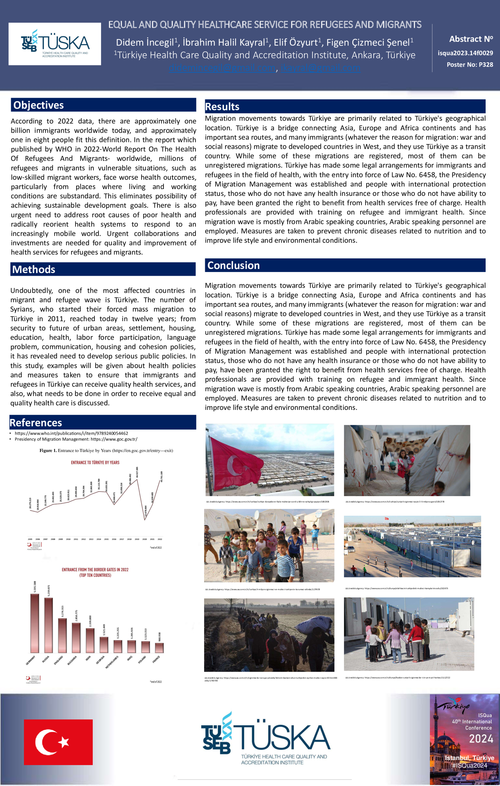
Migration movements towards Türkiye are primarily related to Türkiye's geographical location. Türkiye is a bridge connecting Asia, Europe and Africa continents and has important sea routes, and many immigrants (whatever the reason for migration: war and social reasons) migrate to developed countries in West, and they use Türkiye as a transit country. While some of these migrations are registered, most of them can be unregistered migrations. Türkiye has made some legal arrangements for immigrants and refugees in the field of health, with the entry into force of Law No. 6458, the Presidency of Migration Management was established and people with international protection status, those who do not have any health insurance or those who do not have ability to pay, have been granted the right to benefit from health services free of charge. Health professionals are provided with training on refugee and immigrant health. Since migration wave is mostly from Arabic speaking countries, Arabic speaking personnel are employed. Measures are taken to prevent chronic diseases related to nutrition and to improve life style and environmental conditions.
Conclusion:
The strength of quality in the health services of countries is as strong as its weakest link. Due to war, sociological and economic reasons, countries are exposed to waves of immigrants and refugees like never before in their history. On the one hand they focus on improving quality of health services for their citizens, and on the other hand they strive to create an infrastructure to provide quality service they offer to refugees and immigrants. This situation affects countries both economically and sociologically. Countries should establish cooperation on the solution of this problem and a common solution should be produced. In order to ensure sustainability of health service quality, special health care quality standards for immigrants and refugees should be determined and equal and high quality health care should be provided for everyone.