708 posters, 8 topics, 16 sessions, 1,190 authors, 600 institutions
ePostersLive by SciGen Technologies S.A. All rights reserved.
ISQua's 39th International Conference 2023
August 27 - 30, 2023 | Seoul, Republic of Korea

P325
NOVEL CLINICAL STRATEGIES WITH AI-ASSISTED CHEST-CT LUNG NODULE DETECTION TO INCREASE TRANS-DISCIPLINARY COLLABORATION
Poster Presenter
Part of Topic
Universal Health Coverage and Equity
Novel clinical strategies with AI-assisted Chest-CT lung nodule detection to increase trans-disciplinary collaboration
Chuan-Chou Tu, Tsung-Lung Yang, Hui-Ju Chen, Ko-Shih Chang
Yuan Rung Hospital, Changhua, Taiwan
Introduction:
As a pioneer medical institute wishing to empower lung nodule and cancer detection in central region of Taiwan, introduction of artificial intelligence-assisted interpretation software with the reinforcement of workflow integration under dedicated clinical strategies is critical. Our aim is to encourage screening as well as to reduce the time from screening to screening detected, that is, to shift the time bar of lead time to the left and reduce the time interval between screening and screening detected to achieve effective and high-quality lung nodule and cancer screening.
Keywords: AI, Lung cancer screening, trans-disciplinary collaboration, strategies, SDM
Methods:
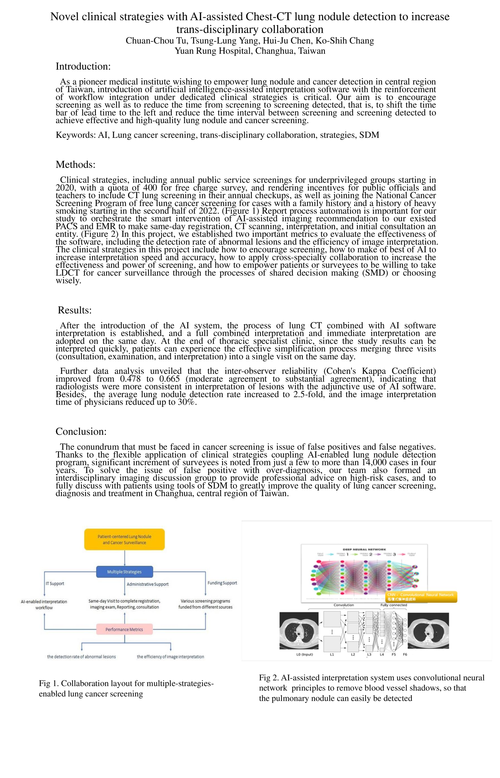
Clinical strategies, including annual public service screenings for underprivileged groups starting in 2020, with a quota of 400 for free charge survey, and rendering incentives for public officials and teachers to include CT lung screening in their annual checkups, as well as joining the National Cancer Screening Program of free lung cancer screening for cases with a family history and a history of heavy smoking starting in the second half of 2022. (Figure 1) Report process automation is important for our study to orchestrate the smart intervention of AI-assisted imaging recommendation to our existed PACS and EMR to make same-day registration, CT scanning, interpretation, and initial consultation an entity. (Figure 2) In this project, we established two important metrics to evaluate the effectiveness of the software, including the detection rate of abnormal lesions and the efficiency of image interpretation. The clinical strategies in this project include how to encourage screening, how to make of best of AI to increase interpretation speed and accuracy, how to apply cross-specialty collaboration to increase the effectiveness and power of screening, and how to empower patients or surveyees to be willing to take LDCT for cancer surveillance through the processes of shared decision making (SMD) or choosing wisely.
Results:
After the introduction of the AI system, the process of lung CT combined with AI software interpretation is established, and a full combined interpretation and immediate interpretation are adopted on the same day. At the end of thoracic specialist clinic, since the study results can be interpreted quickly, patients can experience the effective simplification process merging three visits (consultation, examination, and interpretation) into a single visit on the same day.
Further data analysis unveiled that the inter-observer reliability (Cohen's Kappa Coefficient) improved from 0.478 to 0.665 (moderate agreement to substantial agreement), indicating that radiologists were more consistent in interpretation of lesions with the adjunctive use of AI software. Besides, the average lung nodule detection rate increased to 2.5-fold, and the image interpretation time of physicians reduced up to 30%.
Conclusion:
The conundrum that must be faced in cancer screening is issue of false positives and false negatives. Thanks to the flexible application of clinical strategies coupling AI-enabled lung nodule detection program, significant increment of surveyees is noted from just a few to more than 14,000 cases in four years. To solve the issue of false positive with over-diagnosis, our team also formed an interdisciplinary imaging discussion group to provide professional advice on high-risk cases, and to fully discuss with patients using tools of SDM to greatly improve the quality of lung cancer screening, diagnosis and treatment in Changhua, central region of Taiwan.