708 posters, 8 topics, 16 sessions, 1,190 authors, 600 institutions
ePostersLive by SciGen Technologies S.A. All rights reserved.
ISQua's 39th International Conference 2023
August 27 - 30, 2023 | Seoul, Republic of Korea

P344
POLICY RECOMMENDATIONS ON THE IMPROVEMENT OF PRIMARY HEALTH CARE SERVICE DELIVERY AMONG GOVERNMENT EMPLOYEES: ENABLERS’ PERSPECTIVE
Poster Presenter
Part of Topic
Universal Health Coverage and Equity
Policy Recommendations on the Improvement of Primary Health Care Service Delivery Among Government Employees: Enabler's Perpective
R. NAPULAN, D. DE GUZMAN , A. ONG , J. GITANA, and K. CARLOS
National Research Council of the Philippines
Department of Health, Republic of the Philippines
The Graduate School, University of Santo Tomas
INTRODUCTION
The Philippines enacted the Universal Health Care Act which is anchored on primary health care and mandates the delivery of affordable and quality health services for all.
Memorandum Circular No. 33. s. 1997 - directed the provision of health programs: free annual medical exam to all government agencies
AIM
This paper aims to determine the access to health facilities and services of government employees and their family, the contributing and inhibiting factors, and policy recommendations in improving access.
METHOD
This qualitative study employed key informant interviews (KII) from October 2022 to June 2023. KIIs were conducted with thirteen government institutions. A thematic analysis was done to the responses gathered from the participants through the structured interview guide questions developed.
RESULTS
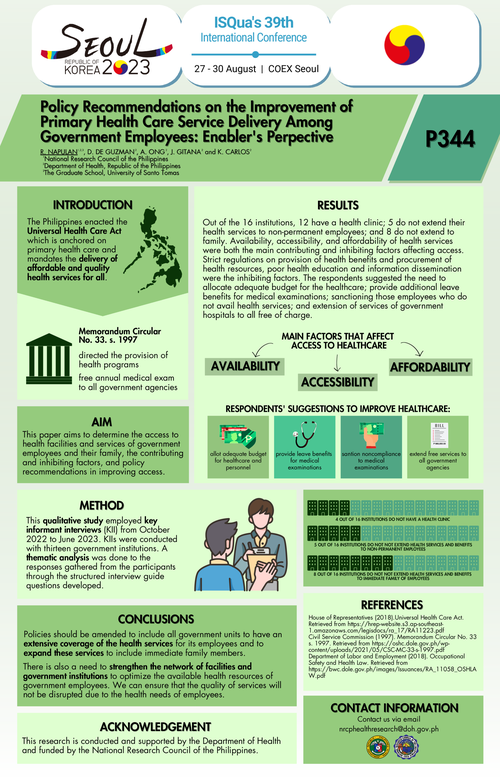
Out of the 16 institutions, 12 have a health clinic; 5 do not extend their health services to non-permanent employees; and 8 do not extend to family. Availability, accessibility, and affordability of health services were both the main contributing and inhibiting factors affecting access. Strict regulations on provision of health benefits and procurement of health resources, poor health education and information dissemination were the inhibiting factors. The respondents suggested the need to allocate adequate budget for the healthcare; provide additional leave benefits for medical examinations; sanctioning those employees who do not avail health services; and extension of services of government hospitals to all free of charge.
CONCLUSIONS
Policies should be amended to include all government units to have an extensive coverage of the health services for its employees and to expand these services to include immediate family members.
There is also a need to strengthen the network of facilities and government institutions to optimize the available health resources of government employees. We can ensure that the quality of services will not be disrupted due to the health needs of employees.
ACKNOWLEDGEMENT
This research is conducted and supported by the Department of Health and funded by the National Research Council of the Philippines.
REFERENCES
House of Representatives (2018).Universal Health Care Act. Retrieved from https://hrep-website.s3.ap-southeast-1.amazonaws.com/legisdocs/ra_17/RA11223.pdf
Civil Service Commission (1997). Memorandum Circular No. 33 s. 1997. Retrieved from https://oshc.dole.gov.ph/wp-content/uploads/2021/05/CSC-MC-33-s-1997.pdf
Department of Labor and Employment (2018). Occupational Safety and Health Law. Retrieved from https://bwc.dole.gov.ph/images/Issuances/RA_11058_OSHLAW.pdf
Contact us via email nrcphealthresearch@doh.gov.ph