708 posters, 8 topics, 16 sessions, 1,190 authors, 600 institutions
ePostersLive by SciGen Technologies S.A. All rights reserved.
ISQua's 39th International Conference 2023
August 27 - 30, 2023 | Seoul, Republic of Korea

P343
IMPLEMENTATION OF A SUSTAINABLE FREE FOOD PROGRAM AT A CANCER PATIENT HOSTEL FOR ECONOMICALLY WEAKER PATIENTS
Poster Presenter
Part of Topic
Universal Health Coverage and Equity
IMPLEMENTATION OF A SUSTAINABLE FREE FOOD PROGRAM AT A CANCER PATIENT HOSTEL FOR ECONOMICALLY WEAKER PATIENTS
Prasanth C. Bhat*, Heena Shaikh, P Thatikonda, K S Panwar
OBJECTIVES
•ACTREC of TMC is an autonomous institution under the central government and is involved in patient care, research, and education in cancer with a mandate to provide subsidised care to 60% of its patients from the economically weaker sections of society.
•Being a premier institution for cancer care, patients come to ACTREC from all over the country and require to stay in Mumbai for sometimes a prolonged period for their treatment. Out of 44941 total registered patients in 2022, 38746 (86.2%) were outstation patients not having residential support in the city.
•ACTREC had a patient hostel for 80 patients with a self-cooking facility. As the center was on the cusp of major expansion from 130 to 900 beds, a new hostel with 260 rooms, 40 dormitory beds, and a cafeteria for dining was built with philanthropic support. On shifting to the new hostel, patients were required to change from self-cooking to enrolling in centre-run mess to meet their dietary needs.
•Though the diets were priced at cost, feedback from the hostel inmates within a month has made it evident to the management that patients (with one caregiver) were finding it difficult to financially sustain the mess bill, especially for a prolonged stay.
•As infrastructure constraints did not permit going back to the self-cooking mode, management was faced with the challenge of how to make the patient's diet much more affordable or free without any compromise on quality or nutritional requirements.
•The management decided to take up the challenge to implement a free food program for hostel inmates with sufficient fundraising for long-term sustenance.
METHODS
Tight cost control:
•Standardised 4 meals a day for each patient with one caregiver through a coupon system
•Costing and budget fixing for different types of diet (regular and special diets)
•Inhouse kitchen with quality raw materials purchased through rate contracts and minimising wastage.
Fund raising strategies
•Corporate Social Responsibilities (CSR) funding through corporate
•Non-Governmental organizations (NGOs) support and individual/business family philanthropy
•Meal sponsorship for special occasions/ birthdays/ remembrance
•Publicity through website/ appeal/ staff sponsorship
CONCLUSION
•Change of systems can lead to unanticipated challenges. Management has to re-strategise and come up with timely sustainable solutions
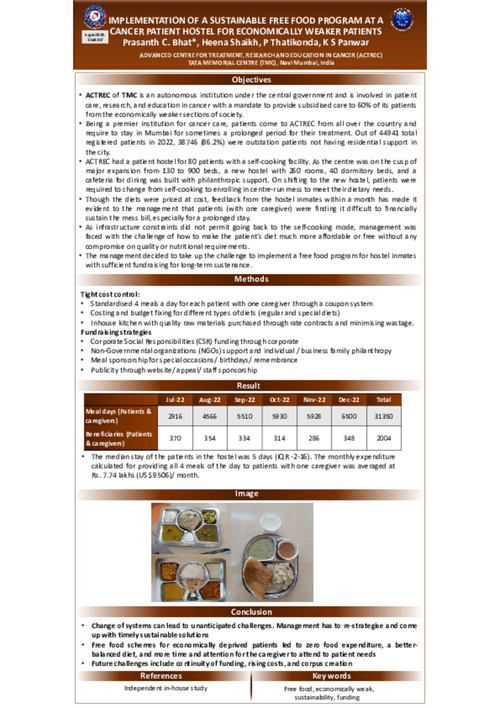
•Free food scheme to economically deprived patients led to zero food expenditure, a better-balanced diet, and more time and attention for the caregiver to attend to patient needs
•Future challenges include continuity of funding, rising costs, and corpus creation