708 posters, 8 topics, 16 sessions, 1,190 authors, 600 institutions
ePostersLive by SciGen Technologies S.A. All rights reserved.
ISQua's 39th International Conference 2023
August 27 - 30, 2023 | Seoul, Republic of Korea

P342
EXAMINING THE IMPACT OF STUDYING ABROAD EXPERIENCE ON STUDENTS' PSYCHOLOGICAL HEALTH DURING COVID-19 PANDEMIC
Part of Topic
Universal Health Coverage and Equity
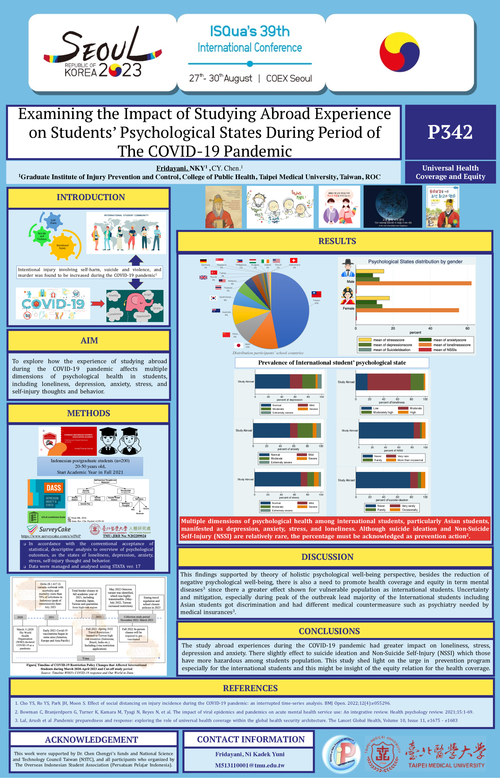
Examining the Impact of Studying Abroad Experience on Students’ Psychological States During Period ofThe COVID-19 Pandemic
Ni Kadek Y. Fridayani* 1, Chenyi Chen1
1Graduate Institute of Injury Prevention and Control, Taipei Medical University, Taipei, Taiwan
Introduction: COVID-19 pandemic in the last two years is considered the worst health crisis since World War II and dramatically changed people’s life, including student activity. Intentional injury involving self-harm, suicide and violence, and murder was found to be increased during the covid-19 pandemic. International students are deemed to be a vulnerable population who have to adapt themselves to new cultural norms and are susceptible to loneliness. The impact of overseas studying experience may exacerbate the adverse effects of the restriction regulations that vary across different countries. However, the interaction between the studying abroad experience and changes in Covid-19-related regulations to depression, stress, anxiety, and self-injury thoughts among international students have not been examined yet. Therefore, this study aims to explore how the experience of studying abroad during covid-19 pandemic affects multiple dimensions of psychological health in students, including loneliness, depression, anxiety, stress, and self-injury thoughts and behaviors.
Methods: This cross-sectional study had a sample of 167. In accordance with the conventional acceptance of statistical significance at a p-value of 0.05, we calculated a confidence interval (CI) of 95%. Participants were Indonesian postgraduate students who were currently studying abroad during data collection. Data was collected through an online survey, within an ethical clearance by TMU-JIRB. UCLA Version 3 was measured for Loneliness. Depression, anxiety, stress, and self-injury thought and behavior were measured by DASS-21 and SITBIs questionnaires. Chi-square analyses were conducted to examine the relationship between the factor of loneliness and depression, anxiety, stress, as well as self-injury thought and behavior. The amounts of time in restriction that varied across different countries were included into a multiple logistic regression to examine whether the variable of restriction policy modulated the relationship between loneliness and psychological health. Data were analyzed using STATA version 17.
Results: The UCLA score showed that more than 65% of students were categorized as having a moderate degree of loneliness. Results of self-injury thought and behavior (SITBs) showed that more than 85% of students did not have self- injury thoughts. However, 53% of students showed mild to extremely severe anxiety, and 38% showed mild to extremely severe depression. Loneliness scores were significantly and positively correlated with depression, anxiety, stress, self- injury thoughts and behavior (all p < 0.05). Students who studied in countries with a less strict restriction policy showed a lower risk of loneliness and a lower ratio of depression, anxiety, stress, as well as self-injury thought and behavior (p < 0.05).
Discussion: This findings supported by theory of holistic psychological well-being perspective, besides the reduction of negative psychological well-being, there is also a need to promote health coverage and equity in term mental diseases3 since there a greater effect shown for vulnerable population as international students. Uncertainty and mitigation, especially during peak of the outbreak lead majority of the International students including Asian students got discrimination and had different medical countermeasure such as psychiatry needed by medical insurances3.
Conclusion: The study abroad experiences during the covid-19 pandemic in countries with a stricter restriction policy increased feelings of loneliness and were associated with a higher risk of depression, anxiety, stress, as well as self- injury thought and behavior. This study shed light on the urge for a prevention program for international students, especially those who studied in countries with stricter restriction policies.
References:
1. Cho YS, Ro YS, Park JH, Moon S. Effect of social distancing on injury incidence during the COVID-19 pandemic: an interrupted time-series analysis. BMJ Open. 2022;12(4):e055296.
2. Bowman C, Branjerdporn G, Turner K, Kamara M, Tyagi N, Reyes N, et al. The impact of viral epidemics and pandemics on acute mental health service use: An integrative review. Health psychology review. 2021;15:1-69.
3. Lal, Arush et al .Pandemic preparedness and response: exploring the role of universal health coverage within the global health security architecture. The Lancet Global Health, Volume 10, Issue 11, e1675 - e1683