708 posters, 8 topics, 16 sessions, 1,190 authors, 600 institutions
ePostersLive by SciGen Technologies S.A. All rights reserved.
ISQua's 39th International Conference 2023
August 27 - 30, 2023 | Seoul, Republic of Korea

P314
APPLYING DIVERSIFIED STRATEGIES TO DECREASING LOSS CHARGE NUMBER OF MEDICAL SUPPLY
Poster Presenter
Authors
Affiliations
Part of Topic
Patient Safety & Quality Improvement
APPLYING DIVERSIFIED STRATEGIES TO DECREASING LOSS CHARGE NUMBER OF MEDICAL SUPPLY
Li-Erh Kuo 1 , Chen-Yi Wang 1 , Ya-Han Yang 1 , Yi Tseng Tsai 1
1 Department of Nursing, An Nan Hospital, China Medical University, Tainan, Taiwan
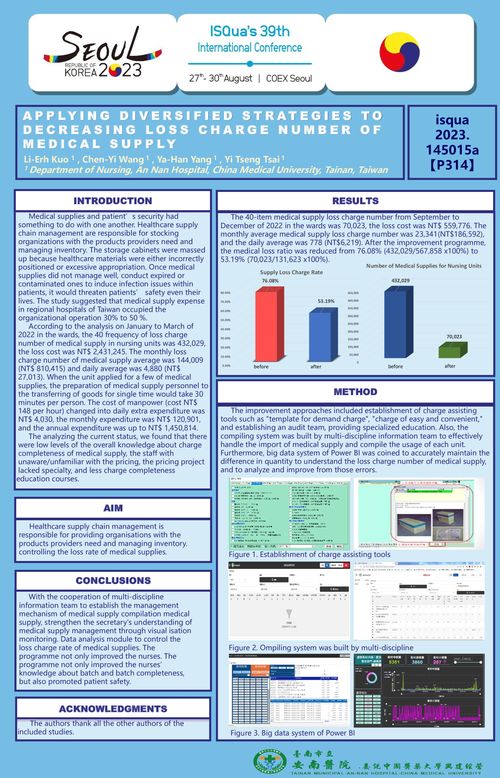
Medical supplies and patient’s security had something to do with one another. Healthcare supply chain management are responsible for stocking organizations with the products providers need and managing inventory. The storage cabinets were massed up because healthcare materials were either incorrectly positioned or excessive appropriation. Once medical supplies did not manage well, conduct expired or contaminated ones to induce infection issues within patients, it would threaten patients’ safety even their lives. The study suggested that medical supply expense in regional hospitals of Taiwan occupied the organizational operation 30% to 50 %. According to the analysis on January to March of 2022 in the wards, the 40 frequency of loss charge number of medical supply in nursing units was 432,029, the loss cost was NT$ 2,431,245. The monthly loss charge number of medical supply average was 144,009 (NT$ 810,415) and daily average was 4,880 (NT$ 27,013). When the unit applied for a few of medical supplies, the preparation of medical supply personnel to the transferring of goods for single time would take 30 minutes per person. The cost of manpower (cost NT$ 148 per hour) changed into daily extra expenditure was NT$ 4,030, the monthly expenditure was NT$ 120,901, and the annual expenditure was up to NT$ 1,450,814. The analyzing the current status, we found that there were low levels of the overall knowledge about charge completeness of medical supply, the staff with unaware/unfamiliar with the pricing, the pricing project lacked specialty, and less charge completeness education courses.