708 posters, 8 topics, 16 sessions, 1,190 authors, 600 institutions
ePostersLive by SciGen Technologies S.A. All rights reserved.
ISQua's 39th International Conference 2023
August 27 - 30, 2023 | Seoul, Republic of Korea

P312
IMPROVING THE QUALITY OF NEONATAL TRANSPORT FOR CRITICALLY ILL NEWBORNS DURING THE COVID-19 PANDEMIC
Poster Presenter
Authors
Affiliations
Part of Topic
Patient Safety & Quality Improvement
INTRODUCTION
According to foreign research, during the pandemic, external
referrals will be subject to epidemic prevention measures and
PCR testing, resulting in increased total referral time and an
increased probability of complications. Due to the impact of
the pandemic, our hospital observed abnormal situations in
external referrals from January to March 2020, including:
• Unstable vital signs: Unexpectedly low body temperature
up to 35%; unexpectedly low blood sugar up to 7%.
• Adverse event rates: Equipment malfunction at 13.7%;
system malfunction at 5.8%.
• Increased total referral time for newborns to 320 minutes.
• Only 32% completion rate for referral forms.
• Inter-hospital collaboration satisfaction rate is only 70%.
Therefore, maintaining the quality of emergency transfers for
critically ill newborns during the pandemic and shortening the
golden time of transfers are crucial.
AIM
We aim to maintain and improve the quality of neonatal
emergency transport, providing safer, faster, professional,
and reliable medical services.
METHOD
During the period from 2nd January 2020 to 31 st December 2021, the following modifications were
made to improve the quality of neonatal transport for critically ill newborns during the COVID-19
pandemic:
• Equipment Updates:
• Updated neonatal transport incubators, ventilators, and physiologic monitors.
• Replaced the first aid kit backpack and establish a standard for spare part inventory.
• Purchased a rapid PCR machine to shorten the time for release from isolation.
• Epidemic Prevention Standard Procedures:
• Establishing the standardized epidemic prevention process for neonatal transport.
• Use of individual protective equipment for physicians and nurses.
• Establishment of epidemic prevention traffic flow and isolation rooms.
• Verification of travel history, occupation, contact history cluster, along with covid-19 PCR testing for
the baby's parents.
• Coordination with hospital guards and disinfection personnel for traffic flow control
• Implementation of well-defined shift handover procedures and infection control strategies.
• Team Resource Management (TRM) Form:
• Revision of the transport form to enhance information communication among personnel and improve
supply accuracy.
• Educational Training:
• Organized the S.T.A.B.L.E. Learner Course to enhance medical staff training and assessment
abilities.
• Optimized Neonatal Ambulance Record Form:
• Improved the form's applicability and increased the integrity of inter-hospital referral handovers.
• Friendly Database Establishment:
• Conducted regular satisfaction surveys and inter-hospital conferences.
RESULTS
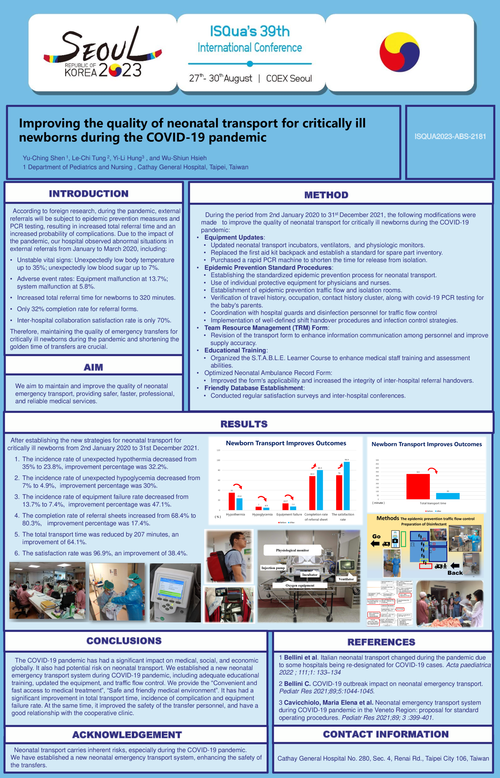
After establishing the new strategies for neonatal transport for
critically ill newborns from 2nd January 2020 to 31st December 2021.
1. The incidence rate of unexpected hypothermia decreased from
35% to 23.8%, improvement percentage was 32.2%.
2. The incidence rate of unexpected hypoglycemia decreased from
7% to 4.9%, improvement percentage was 30%.
3. The incidence rate of equipment failure rate decreased from
13.7% to 7.4%, improvement percentage was 47.1%.
4. The completion rate of referral sheets increased from 68.4% to
80.3%, improvement percentage was 17.4%.
5. The total transport time was reduced by 207 minutes, an
improvement of 64.1%.
6. The satisfaction rate was 96.9%, an improvement of 38.4%.
CONCLUSIONS
The COVID-19 pandemic has had a significant impact on medical, social, and economic
globally. It also had potential risk on neonatal transport. We established a new neonatal
emergency transport system during COVID-19 pandemic, including adequate educational
training, updated the equipment, and traffic flow control. We provide the “Convenient and
fast access to medical treatment”, “Safe and friendly medical environment”. It has had a
significant improvement in total transport time, incidence of complication and equipment
failure rate. At the same time, it improved the safety of the transfer personnel, and have a
good relationship with the cooperative clinic.
ACKNOWLEDGEMENT
Neonatal transport carries inherent risks, especially during the COVID-19 pandemic.
We have established a new neonatal emergency transport system, enhancing the safety of
the transfers.
REFERENCES
1 Bellini et al. Italian neonatal transport changed during the pandemic due
to some hospitals being re-designated for COVID-19 cases. Acta paediatrica
2022 ; 111;1: 133–134
2 Bellini C. COVID-19 outbreak impact on neonatal emergency transport.
Pediatr Res 2021;89;5:1044-1045.
3 Cavicchiolo, Maria Elena et al. Neonatal emergency transport system
during COVID-19 pandemic in the Veneto Region: proposal for standard
operating procedures. Pediatr Res 2021;89; 3 :399-401.
CONTACT INFORMATION
Cathay General Hospital No. 280, Sec. 4, Renai Rd., Taipei City 106, Taiwan