708 posters, 8 topics, 16 sessions, 1,190 authors, 600 institutions
ePostersLive by SciGen Technologies S.A. All rights reserved.
ISQua's 39th International Conference 2023
August 27 - 30, 2023 | Seoul, Republic of Korea

P291
SERIOUS ADVERSE EVENT REVIEW (SAER) ROOT CAUSE ANALYSIS 20 YEARS ON IN THE NSW HEALTH SYSTEM: HAS THERE BEEN A REDUCTION IN PATIENT HARM?
Poster Presenter
Part of Topic
Patient Safety & Quality Improvement
Title:
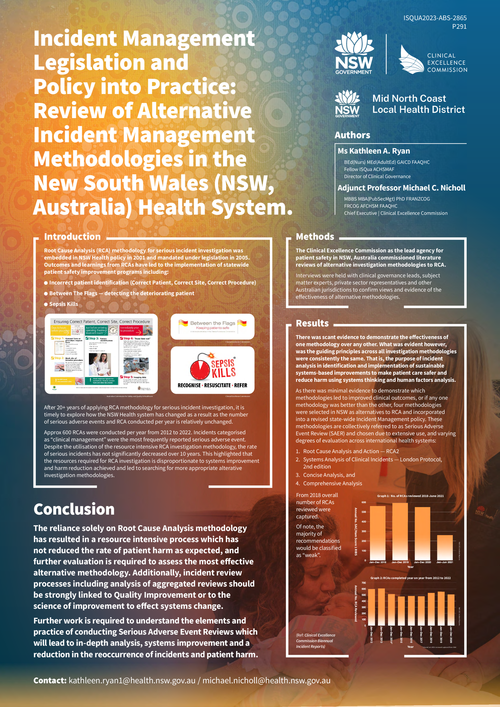
Incident Management Legislation and Policy into Practice: Review of Alternative Incident Management Methodologies in the New South Wales (NSW, Australia) Health System.
Introduction:
Root Cause Analysis (RCA) methodology for serious incident investigation was embedded in NSW Health policy in 2001 and mandated under legislation in 2005. Outcomes and learnings from RCAs have led to the implementation of statewide patient safety improvement programs including:
- Incorrect patient identification (Correct Patient, Correct Site, Correct Procedure)
Insert Image - Between The Flags - detecting the deteriorating patient.
Insert Image - Sepsis Kills
Insert Image
After 20+ years of applying RCA methodology for serious incident investigation, it is timely to explore how the NSW Health system has changed as a result as the number of serious adverse events and RCA conducted per year is relatively unchanged.
Approx 600 RCAs were conducted over 10 years from 2012 to 2022, with incidents relating to clinical management recorded as the most frequently reported serious adverse event. As the rate of serious incidents has not decreased despite the resource intensive RCA investigation methodology, this is disproportionate to systems improvement and harm reduction, and has led to searching for more appropriate alterative investigation methodologies.
Methods:
The Clinical Excellence Commission as the lead agency for patient safety in NSW, Australia commissioned literature reviews of alternative investigation methodologies to RCA. Interviews were held with clinical governance leads, subject matter experts, private sector representatives and other Australian jurisdictions to confirm views and evidence of the effectiveness of alternative methodologies.
Results:
There was scant evidence to demonstrate the effectiveness of one methodology over any other. What was evident however, was the guiding principles across all investigation methodologies were consistently the same. That is, the purpose of incident analysis in identification and implementation of sustainable systems-based improvements to make patient care safer and reduce harm using systems thinking and human factors analysis.
As there was minimal evidence to demonstrate which methodologies led to improved clinical outcomes, or if any one methodology was better than the other, four methodologies were selected in NSW as alternatives to RCA in NSW and included in a revised Incident Management policy. The four following methodologies are collectively referred to as Serious Adverse Event Review (SAER) were chosen as they are used extensively across various health systems :
- Root Cause Analysis and Action - RCA2
- Systems Analysis of Clinical Incidents - London Protocol, 2nd edition
- Concise Analysis, and
- Comprehensive Analysis
Conclusion:
The reliance solely on RCA methodology has resulted in a resource intensive process which has not reduced the rate of patient harm as expected, and further evaluation is required to assess the most effective alternative methodology. Additionally, incident review processes including analysis of aggregated reviews should be strongly linked to Quality Improvement or to the science of improvement to effect systems change.
Further work is required to understand the elements and practice of conducting SAERs which will lead to in-depth analysis, systems improvement and a reduction in the reoccurrence of incidents and patient harm.
Contact: kathleen.ryan1@health.nsw.gov.au / michael.nicholl@health.nsw.gov.au