708 posters, 8 topics, 16 sessions, 1,190 authors, 600 institutions
ePostersLive by SciGen Technologies S.A. All rights reserved.
ISQua's 39th International Conference 2023
August 27 - 30, 2023 | Seoul, Republic of Korea

P288
MODIFIABLE RISK FACTORS FOR DIAGNOSED STROKE IN THE ADULT INDONESIAN POPULATION: A LONGITUDINAL STUDY BASED ON THE 2007 AND 2014 FAMILY LIFE SURVEY (IFLS)
Poster Presenter
Authors
Affiliations
Part of Topic
Patient Safety & Quality Improvement
MODIFIABLE RISK FACTORS FOR DIAGNOSED STROKE IN THE ADULT INDONESIAN POPULATION: A LONGITUDINAL STUDY BASED ON THE 2007 AND 2014 FAMILY LIFE SURVEY (IFLS)
Latief, K* 1, 2, D Nurrika3, W Gao1
1Global Health & Health Security, Taipei Medical University, Taipei, Taiwan, 2The Center for Family Welfare, Faculty of Public Health, University of Indonesia, Depok, Indonesia, Depok, 3Public Health, Banten School of Health Science, Ministry of Research, Technology and Higher Education, Higher Education Service Institutions (LL-DIKTI) Region IV, Bandung, West Java, Indonesia, South Tangerang, Indonesia
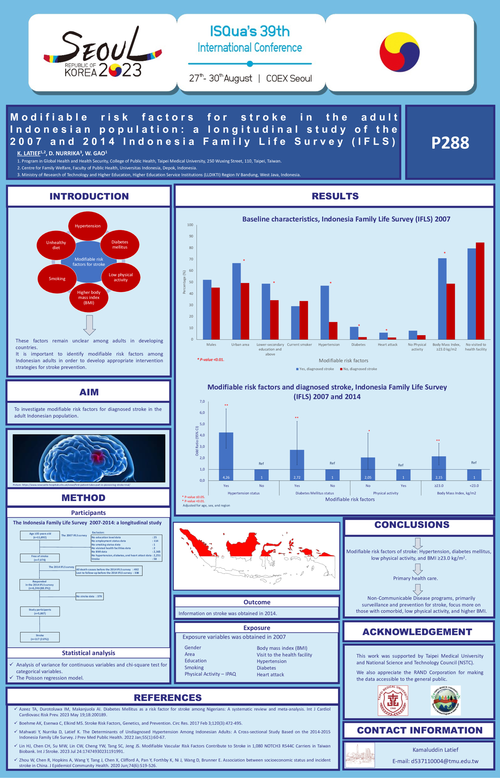
Introduction: The modifiable risk factors of diagnosed stroke, such as hypertension status, diabetes mellitus status, physical activity, and Body Mass Index (BMI), are essential, as intervention strategies aimed at reducing these factors can subsequently reduce the risk of stroke in developed countries. This association among adults in developing countries, however, remains unclear. The present study was to investigate modifiable risk factors for diagnosed stroke in the adult Indonesian population.
Methods: A 7-year prospective longitudinal study (2007-2014) was conducted on 5,867 adult Indonesian individuals (≥ 35 years). The exposure variables were modifiable risk factors (i.e., hypertension and diabetes mellitus status, physical activity, and BMI). The outcome variable was a diagnosed stroke, defined as participants who reported having had a stroke and been informed by a health professional. Data on modifiable risk factors were collected in 2007. Information on diagnosed strokes was obtained in both 2007 and 2014. The data in this study were analyzed using logistic regression.
Results: Among 5,867 participants, the prevalence of a diagnosed stroke was 2.0%. The odds ratios (ORs) and 95% confidence intervals (CIs) of a diagnosed stroke were significantly higher among participants who have hypertension (OR, 4.26; 95% CI, 2.86-6.35) as compared with those who did not have hypertension. The participants with diabetes mellitus (OR, 2.72; 95% CI, 1.40-5.24), those who do not do physical activity (OR, 2.05; 95% CI, 1.00-4.19), and those who had a BMI ≥23.0 kg/ m2 (OR, 2.15, 95% CI, 1.39-3.30) also had a higher probability of a diagnosed stroke than those who do not have diabetes mellitus, do physical activity, and have a BMI<23.0 kg/m2.
Conclusion: Hypertension, diabetes mellitus, physical activity, and those with a BMI ≥23.0 kg/ m2 as modifiable risk factors for a diagnosed stroke. Our study suggests that Non-Communicable Disease programs, primarily surveillance and treatment for stroke in primary health care, focus more on those with comorbid, low physical activity, and higher BMI.
REFERENCES