708 posters, 8 topics, 16 sessions, 1,190 authors, 600 institutions
ePostersLive by SciGen Technologies S.A. All rights reserved.
ISQua's 39th International Conference 2023
August 27 - 30, 2023 | Seoul, Republic of Korea

P286
INTERNATIONAL STANDARD ISO15189 EFFECTIVENESS IN ASSISTING ORGANIZATIONS TO MANAGE INTERDEPARTMENTAL POCT SERVICES
Poster Presenter
Authors
Affiliations
Part of Topic
Patient Safety & Quality Improvement
International Standard ISO15189 Effectiveness in Assisting Organizations to Manage Interdepartmental POCT Services
Jung-Chun Chang1 、 Chiung-Tzu Hsiao2、Yi-Min Hsu3 、Po-Ren Hsueh2
1 Department of Medicine Quality, 2Department of Laboratory Medicine, 3Department of Nursing,
China Medical University Hospital(TAIWAN)
Purpose : The need to introduce point-of-care testing (POCT) is increasing in response to the demand for medical services. POCT is beneficial in clinical practice as it eliminates the need for complex handling processes of samples in laboratories; as such, testing results can be obtained more quickly. Point-of-care testing can be operated at the bedside in hospital wards, in examination rooms, or outside medical laboratories (testing departments). This involves more people with non-medical testing backgrounds performing the tests. Under such circumstances, it is essential to establish an effective management system. In the case of blood glucose machines, the ISO15189 quality system concept was introduced into POCT management by the laboratory department to encourage interdepartmental collaboration with the nursing and medical engineering departments. Many issues were found in the testing and post-testing processes by collecting data on various problems and holding regular review meetings with the testing, nursing, and medical staff. As such, these problems were addressed one by one utilizing this study's interdepartmental management model, effectively improving the POCT performance, and controlling the use of instruments, which led to the accuracy of reporting results.
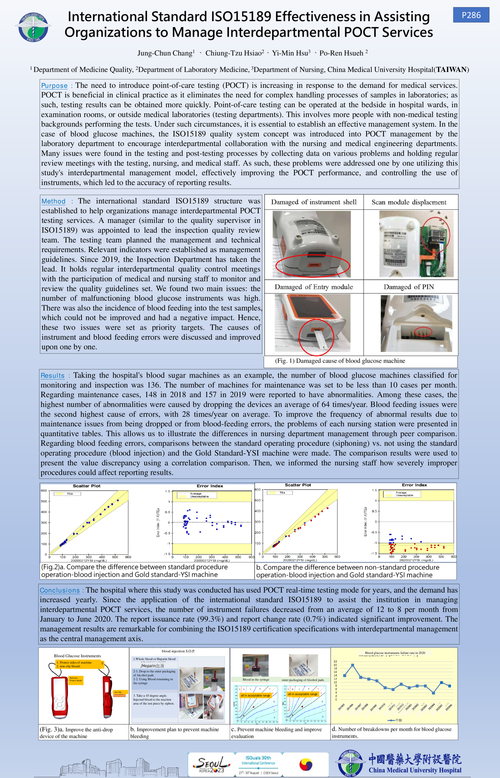
Method : The international standard ISO15189 structure was established to help organizations manage interdepartmental POCT testing services. A manager (similar to the quality supervisor in ISO15189) was appointed to lead the inspection quality review team. The testing team planned the management and technical requirements. Relevant indicators were established as management guidelines. Since 2019, the Inspection Department has taken the lead. It holds regular interdepartmental quality control meetings with the participation of medical and nursing staff to monitor and review the quality guidelines set. We found two main issues: the number of malfunctioning blood glucose instruments was high. There was also the incidence of blood feeding into the test samples, which could not be improved and had a negative impact. Hence, these two issues were set as priority targets. The causes of instrument and blood feeding errors were discussed and improved upon one by one.
Results : Taking the hospital's blood sugar machines as an example, the number of blood glucose machines classified for monitoring and inspection was 136. The number of machines for maintenance was set to be less than 10 cases per month. Regarding maintenance cases, 148 in 2018 and 157 in 2019 were reported to have abnormalities. Among these cases, the highest number of abnormalities were caused by dropping the devices an average of 64 times/year. Blood feeding issues were the second highest cause of errors, with 28 times/year on average. To improve the frequency of abnormal results due to maintenance issues from being dropped or from blood-feeding errors, the problems of each nursing station were presented in quantitative tables. This allows us to illustrate the differences in nursing department management through peer comparison. Regarding blood feeding errors, comparisons between the standard operating procedure (siphoning) vs. not using the standard operating procedure (blood injection) and the Gold Standard-YSI machine were made. The comparison results were used to present the value discrepancy using a correlation comparison. Then, we informed the nursing staff how severely improper procedures could affect reporting results.
Conclusions : The hospital where this study was conducted has used POCT real-time testing mode for years, and the demand has increased yearly. Since the application of the international standard ISO15189 to assist the institution in managing interdepartmental POCT services, the number of instrument failures decreased from an average of 12 to 8 per month from January to June 2020. The report issuance rate (99.3%) and report change rate (0.7%) indicated significant improvement. The management results are remarkable for combining the ISO15189 certification specifications with interdepartmental management as the central management axis.