708 posters, 8 topics, 16 sessions, 1,190 authors, 600 institutions
ePostersLive by SciGen Technologies S.A. All rights reserved.
ISQua's 39th International Conference 2023
August 27 - 30, 2023 | Seoul, Republic of Korea

P284
CHANGE MANAGEMENT: SETTING UP QUALITY DEPARTMENT – FROM NOTHING TO SOMETHING
Poster Presenter
Authors
Affiliations
Part of Topic
Patient Safety & Quality Improvement
Introduction:
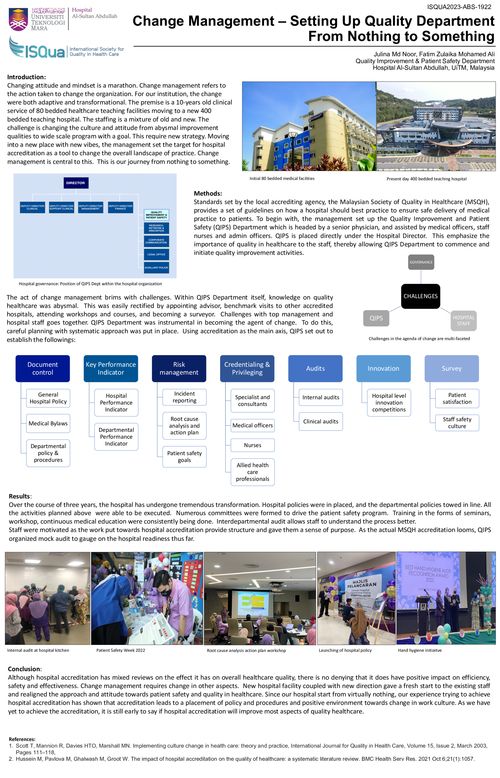
Changing attitude and mindset is a marathon. Change management refers to the action taken to change the organization. For our institution, the change were both adaptive and transformational. The premise is a 10-years old clinical service of 80 bedded healthcare teaching facilities moving to a new 400 bedded teaching hospital. The staffing is a mixture of old and new. The challenge is changing the culture and attitude from abysmal improvement qualities to wide scale program with a goal. This require new strategy. Moving into a new place with new vibes, the management set the target for hospital accreditation as a tool to change the overall landscape of practice. Change management is central to this. This is our journey from nothing to something.
Methods:
Standards set by the local accrediting agency, the Malaysian Society of Quality in Healthcare (MSQH), provides a set of guidelines on how a hospital should best practice to ensure safe delivery of medical practice to patients. To begin with, the management set up the Quality Improvement and Patient Safety (QIPS) Department which is headed by a senior physician, and assisted by medical officers, staff nurses and admin officers. QIPS is placed directly under the Hospital Director. This emphasize the importance of quality in healthcare to the staff, thereby allowing QIPS Department to commence and initiate quality improvement activities.
The act of change management brims with challenges. Within QIPS Department itself, knowledge on quality healthcare was abysmal. This was easily rectified by appointing advisor, benchmark visits to other accredited hospitals, attending workshops and courses, and becoming a surveyor. Challenges with top management and hospital staff goes together. QIPS Department was instrumental in becoming the agent of change. To do this, careful planning with systematic approach was put in place. Using accreditation as the main axis, QIPS set out to establish the followings:
Results:
Over the course of three years, the hospital has undergone tremendous transformation. Hospital policies were in placed, and the departmental policies towed in line. All the activities planned above were able to be executed. Numerous committees were formed to drive the patient safety program. Training in the forms of seminars, workshop, continuous medical education were consistently being done. Interdepartmental audit allows staff to understand the process better.
Staff were motivated as the work put towards hospital accreditation provide structure and gave them a sense of purpose. As the actual MSQH accreditation looms, QIPS organized mock audit to gauge on the hospital readiness thus far.
Conclusion:
Although hospital accreditation has mixed reviews on the effect it has on overall healthcare quality, there is no denying that it does have positive impact on efficiency, safety and effectiveness. Change management requires change in other aspects. New hospital facility coupled with new direction gave a fresh start to the existing staff and realigned the approach and attitude towards patient safety and quality in healthcare. Since our hospital start from virtually nothing, our experience trying to achieve hospital accreditation has shown that accreditation leads to a placement of policy and procedures and positive environment towards change in work culture. As we have yet to achieve the accreditation, it is still early to say if hospital accreditation will improve most aspects of quality healthcare.