708 posters, 8 topics, 16 sessions, 1,190 authors, 600 institutions
ePostersLive by SciGen Technologies S.A. All rights reserved.
ISQua's 39th International Conference 2023
August 27 - 30, 2023 | Seoul, Republic of Korea

P283
SURVEY OF PATIENT SAFETY CULTURE IN A NEW TEACHING HOSPITAL
Poster Presenter
Authors
Affiliations
Part of Topic
Patient Safety & Quality Improvement
SURVEY OF PATIENT SAFETY CULTURE
Fatim Zulaika Mohamed Ali, Julina Md Noor
Quality Improvement & Patient Safety Department
Hospital Al-Sultan Abdullah, Universiti Teknologi MARA, Malaysia
INTRODUCTION
Hospital Al-Sultan Abdullah (HASA), under Universiti Teknologi Mara (UiTM), a new teaching hospital, established in March 2021, providing comprehensive healthcare services and practical training to future medical professionals. Beforehand, the hospital functioned as a small training center under the Faculty of Medicine UiTM, known as UiTM Medical Specialist Centre, since 2010. However, the transition to a larger teaching hospital posed challenges in establishing a cohesive patient safety culture due to the diverse staff backgrounds. The hospital's management and leadership are now prioritizing efforts to address this issue and foster a strong safety culture to ensure the best patient care provided in HASA. The Malaysian Society for Quality in Health (MSQH), an organization that promotes and maintains quality and safety standards in healthcare services in Malaysia, facilitates our hospital initiatives through accreditation programs. In 2022, a comprehensive survey involving 301 diverse staff members assessed patient safety culture to identify strengths and areas for improvement, aiming for the highest standards of patient care and safety through continuous improvement.
METHODOLOGY
Between 1st November 2022 and 15th December 2022, a cross-sectional study was conducted at the hospital using the Hospital Survey on Patient Safety Culture (HSOPS), a validated tool developed by AHRQ. The survey questions were translated and validated in the local language, Malay language. A total of 301 staff members participated by completing and returning the distributed questionnaire. The survey utilized a ten-area framework to identify potential areas of improvement, and the results were presented as composite measures. These areas encompassed supervisor, manager, or clinical leader support for patient safety, teamwork, communication openness, reporting of patient safety events, organizational learning, communication about errors, hospital management support for patient safety, response to errors, handoffs and information exchange, and staffing and work pace.
RESULT
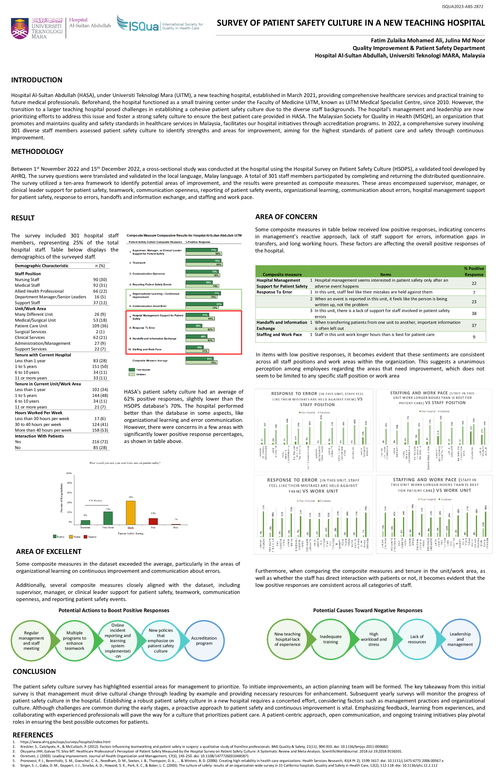
The survey included 301 hospital staff members, representing 25% of the total hospital staff. Table below displays the demographics of the surveyed staff.
HASA's patient safety culture had an average of 62% positive responses, slightly lower than the HSOPS database's 70%. The hospital performed better than the database in some aspects, like organizational learning and error communication. However, there were concerns in a few areas with significantly lower positive response percentages, as shown in table above.
AREA OF EXCELLENT
Some composite measures in the dataset exceeded the average, particularly in the areas of organizational learning on continuous improvement and communication about errors.
Additionally, several composite measures closely aligned with the dataset, including supervisor, manager, or clinical leader support for patient safety, teamwork, communication openness, and reporting patient safety events.
AREA OF CONCERN
Some composite measures in table below received low positive responses, indicating concerns in management's reactive approach, lack of staff support for errors, information gaps in transfers, and long working hours. These factors are affecting the overall positive responses of the hospital.
In items with low positive responses, it becomes evident that these sentiments are consistent across all staff positions and work areas within the organization. This suggests a unanimous perception among employees regarding the areas that need improvement, which does not seem to be limited to any specific staff position or work area
Furthermore, when comparing the composite measures and tenure in the unit/work area, as well as whether the staff has direct interaction with patients or not, it becomes evident that the low positive responses are consistent across all categories of staff.
CONCLUSION
The patient safety culture survey has highlighted essential areas for management to prioritize. To initiate improvements, an action planning team will be formed. The key takeaway from this initial survey is that management must drive cultural change through leading by example and providing necessary resources for enhancement. Subsequent yearly surveys will monitor the progress of patient safety culture in the hospital. Establishing a robust patient safety culture in a new hospital requires a concerted effort, considering factors such as management practices and organizational culture. Although challenges are common during the early stages, a proactive approach to patient safety and continuous improvement is vital. Emphasizing feedback, learning from experiences, and collaborating with experienced professionals will pave the way for a culture that prioritizes patient care. A patient-centric approach, open communication, and ongoing training initiatives play pivotal roles in ensuring the best possible outcomes for patients.