708 posters, 8 topics, 16 sessions, 1,190 authors, 600 institutions
ePostersLive by SciGen Technologies S.A. All rights reserved.
ISQua's 39th International Conference 2023
August 27 - 30, 2023 | Seoul, Republic of Korea

P282
AMERICAN ACADEMY OF PEDIATRICS IMPLEMENTATION TOOLKIT TO PREVENT HOME MEDICATION ADMINISTRATION ERRORS IN CHILDREN WITH MEDICAL COMPLEXITY
Poster Presenter
Authors
Affiliations
Part of Topic
Patient Safety & Quality Improvement
AMERICAN ACADEMY OF PEDIATRICS IMPLEMENTATION TOOLKIT TO PREVENT HOME MEDICATION
ADMINISTRATION ERRORS IN CHILDREN WITH MEDICAL COMPLEXITY
Julia Kim, MD, MPH 1, 2 , Ulfat Shaikh, MD, MPH, MS 2, 3 , Shonna Yin, MD, MSc 2, 4
1 Pediatrics, Johns Hopkins University School of Medicine, Baltimore
2 American Academy of Pediatrics, Council on Quality Improvement and Patient Safety, Itasca,
3 Pediatrics, University of California David School of Medicine, Sacramento,
4 Pediatrics, NYU School of Medicine, New York, United States
Introduction: Pediatric out-of-hospital medication errors are a frequently occurring patient safety issue,
especially in children with medical complexity. The American Academy of Pediatrics' (AAP) Policy Statement,
“Preventing Home Medication Administration Errors” was published in 2021 and provides an actionable
framework and recommendations to address this problem. The AAP’s Council on Quality Improvement and
Patient Safety (COQIPS) develops and promotes innovations and activities supporting the integration of policy
and practice, education, advocacy, and implementation around the topic areas of quality improvement and
patient safety. To facilitate the implementation of recommendations in the “Preventing Home Medication
Administration Errors'' policy statement into clinical practice, COQIPS developed a companion implementation
toolkit. We describe the toolkit to prevent home medication errors and identified which aspects of the toolkit
were considered feasible and important to implement.
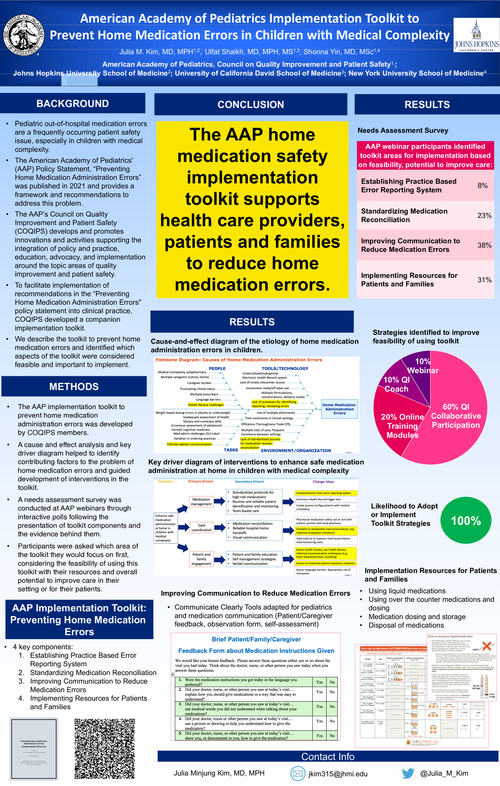
Methods: The AAP implementation toolkit to prevent home medication administration errors was developed by COQIPS
members. A cause and effect analysis and key driver diagram helped to identify contributing factors to the problem of
home medication errors and guided the development of interventions in the toolkit. A needs assessment survey was
conducted at AAP webinars through interactive polls following the presentation of toolkit components and the evidence
behind them. Participants were asked which area of the toolkit they would focus on first, considering the feasibility of
using this toolkit with their resources and overall potential to improve care in their setting or for their patients.
Results: The implementation tookit focused on 4 key components: Establishing Practice Based Error Reporting System,
Standardizing Medication Reconciliation, Improving Communication to Reduce Medication Errors, and Resources for
Patients and Families. Most participants responded that they would work on implementing strategies to improve
communication to reduce medication errors (38%). Participants also identified implementation resources for patients and
families (31%), standardizing medication reconciliation (23%), and establishing practice-based error reporting systems
(8%) as their next steps. When asked which strategies would improve the feasibility of using the toolkit at their institution,
60% identified participation in a quality improvement collaborative as the most helpful strategy, 20% picked online
modules and 10% identified external facilitation by a QI coach, and 10% picked educational webinar series. 100% of
participants were likely or very likely to adopt or implement strategies.
Conclusion: This toolkit will support the ability of health care providers to reduce home medication errors by: developing
practice-based error-reporting systems, setting up systems to promote medication reconciliation, especially at times of
transition, promoting systems-level approaches to integrating health literacy-informed best practices into routine care,
including use of health literacy-informed counseling strategies and educational materials to support provision of
straightforward and actionable instructions, and empower caregivers to engage in care.