708 posters, 8 topics, 16 sessions, 1,190 authors, 600 institutions
ePostersLive by SciGen Technologies S.A. All rights reserved.
ISQua's 39th International Conference 2023
August 27 - 30, 2023 | Seoul, Republic of Korea

P280
QUALITY AND SAFETY CONSIDERATIONS IN TRAINING FUTURE CLINICIANS
Poster Presenter
Part of Topic
Patient Safety & Quality Improvement
QUALITY AND SAFETY CONSIDERATIONS IN TRAINING FUTURE CLINICIANS
Introduction: Pressures from the COVID-19 pandemic have magnified ongoing concerns over workforce adequacy and competency. Clinicians-in-training represents a significant share of the health care workforce. Research has demonstrated the long-term influence of the clinical learning environment on patterns of practice (Asch, Chen), making these trends important considerations in improving post-graduate medical education (PGME) and the quality-of-care trainees provide.
Aim: Educational trends carry the potential to impact the quality and safety of care delivered by trainees and their work settings. Health care leaders need to understand and contextualize trends that will impact the competencies of the future clinical workforce. The objective is to identify and evaluate current PGME trends based on their contributions to strengthen a culture of quality and safety in the clinical learning environment.
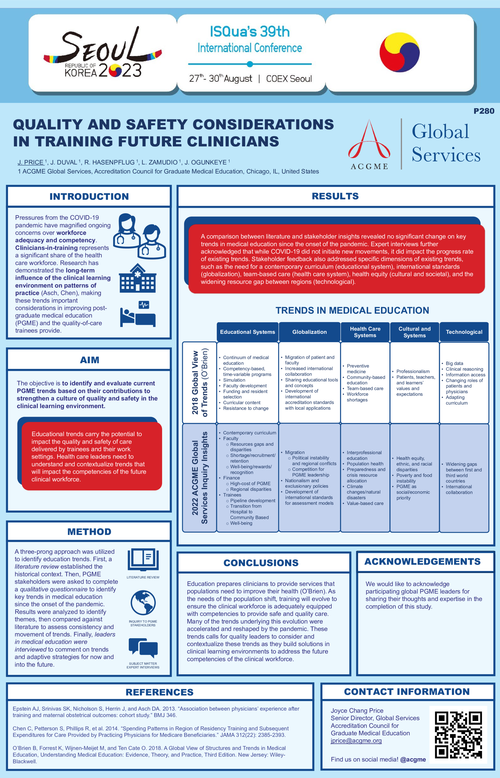
Method: A three-prong approach was utilized to identify education trends. First, a literature review established the historical context. Then, PGME stakeholders were asked to complete a qualitative questionnaire to identify key trends in medical education since the onset of the pandemic. Results were analyzed to identify themes, then compared against literature to assess consistency and movement of trends. Finally, leaders in medical education were interviewed to comment on trends and adaptive strategies for now and into the future.
Results: A comparison between literature and stakeholder insights revealed no significant change on key trends in medical education since the onset of the pandemic. Expert interviews further acknowledged that while COVID-19 did not initiate new movements, it did impact the progress rate of existing trends. Stakeholder feedback also addressed specific dimensions of existing trends, such as the need for a contemporary curriculum (educational system), international standards (globalization), team-based care (health care system), health equity (cultural and societal), and the widening resource gap between regions (technological).
Conclusions: Education prepares clinicians to provide services that populations need to improve their health (O’Brien). As the needs of the population shift, training will evolve to ensure the clinical workforce is adequately equipped with competencies to provide safe and quality care. Many of the trends underlying this evolution were accelerated and reshaped by the pandemic. These trends calls for quality leaders to consider and contextualize these trends as they build solutions in clinical learning environments to address the future competencies of the clinical workforce.
References:
Epstein AJ, Srinivas SK, Nicholson S, Herrin J, and Asch DA. 2013. “Association between physicians’ experience after training and maternal obstetrical outcomes: cohort study.” BMJ 346.
Chen C, Petterson S, Phillips R, et al. 2014. “Spending Patterns in Region of Residency Training and Subsequent Expenditures for Care Provided by Practicing Physicians for Medicare Beneficiaries.” JAMA 312(22): 2385-2393.
O’Brien B, Forrest K, Wijnen-Meijet M, and Ten Cate O. 2018. A Global View of Structures and Trends in Medical Education, Understanding Medical Education: Evidence, Theory, and Practice, Third Edition. New Jersey: Wiley-
Blackwell.