708 posters, 8 topics, 16 sessions, 1,190 authors, 600 institutions
ePostersLive by SciGen Technologies S.A. All rights reserved.
ISQua's 39th International Conference 2023
August 27 - 30, 2023 | Seoul, Republic of Korea

ISQUA2023-ABS-2247
THE EFFECT OF DEVELOPMENT AND IMPLEMENTATION OF CARDIAC ARREST RESPONSE PROTOCOL OUTSIDE THE WARD: THE QUALITY IMPROVEMENT INITIATIVE
Poster Presenter
Authors
Affiliations
Part of Topic
Patient Safety & Quality Improvement
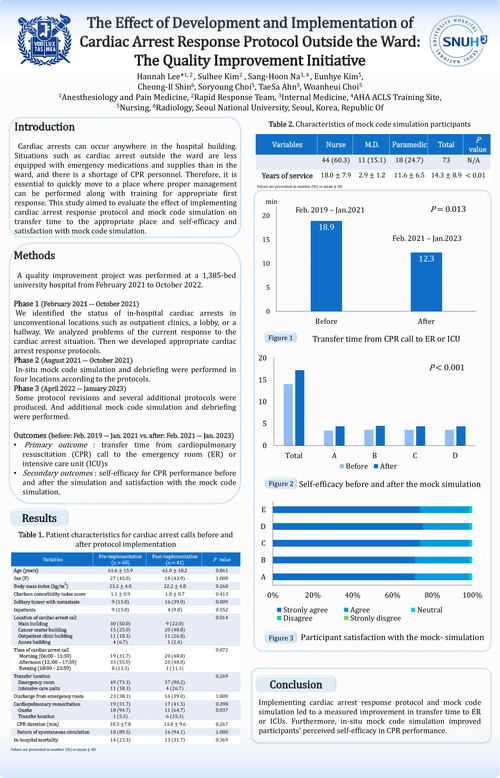
Introduction: Cardiac arrests can occur anywhere in the hospital building. Situations such as cardiac arrest outside the ward are less equipped with emergency medications and supplies than in the ward, and there is a shortage of CPR personnel. Therefore, along with training for appropriate first response at the scene of a cardiac arrest, it is essential to move quickly to a place where proper management can be provided This study aimed to evaluate the effect of implementing cardiac arrest response protocol and mock code simulation on transfer time to the appropriate place and self-efficacy and satisfaction with mock code simulation.
Methods: A quality improvement project was performed at a 1,385-bed university hospital from February 2021 to January 2023. During phase 1, we identified the status of in-hospital cardiac arrests in unconventional locations such as outpatient clinics, a lobby, or a hallway. We analyzed problems of the current response to the cardiac arrest situation. Then we developed appropriate cardiac arrest response protocols. During phase 2, in-situ mock code simulation and debriefing were performed in four locations according to the protocols. During phase 3, some protocol revisions and several additional protocols were produced. And additional mock code simulation and debriefing were performed. The primary outcome was transfer time from cardiopulmonary resuscitation (CPR) call to the emergency room (ER) or intensive care unit (ICU)s comparing with the pre-intervention period (February 2019 to January 2021). And secondary outcomes were self-efficacy for CPR performance before and after the simulation and satisfaction with the mock code simulation.
Results: A total of thirty-five protocols were developed according to the characteristics of each location. There were 60 cardiac arrest calls before the intervention and 41 calls after the intervention. And 32 mock code simulations were run in sixteen different locations. Mean (SD) transfer time to ER or ICUs was 12.3 (5.5) min after the intervention, whereas it was 18.5 (18.0) min before the intervention (P = 0.015). Seventy three participants of the mock code simulation completed the questionnaire. Self-efficacy for CPR performance was significantly improved after the simulation (P < 0.001)
Conclusion: Implementing cardiac arrest response protocol and mock code simulation led to a measured improvement in transfer time to ER or ICUs. Furthermore, in-situ mock code simulation improved participants' perceived self-efficacy in CPR performance.