708 posters, 8 topics, 16 sessions, 1,190 authors, 600 institutions
ePostersLive by SciGen Technologies S.A. All rights reserved.
ISQua's 39th International Conference 2023
August 27 - 30, 2023 | Seoul, Republic of Korea

P274
Developments of Healthcare Quality of Attention Deficit Hyperactivity Disorder(ADHD) in South Korea.
Poster Presenter
Authors
Affiliations
Part of Topic
Patient Safety & Quality Improvement
OBJECTIVE
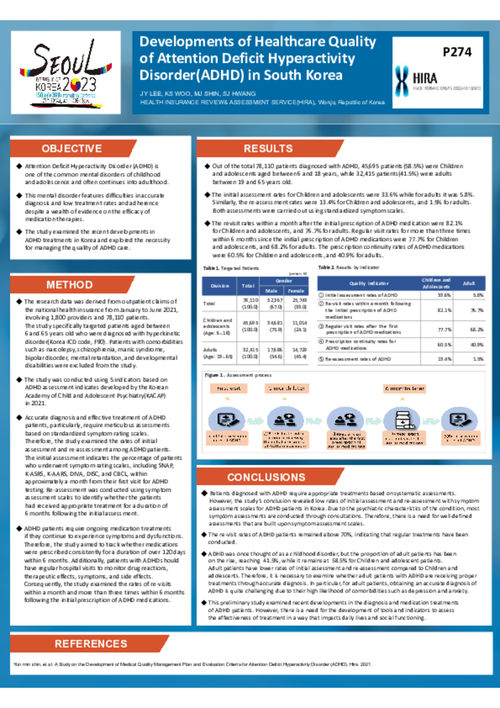
Attention Deficit Hyperactivity Disorder (ADHD) is one of the common mental disorders of childhood and adolescence and often continues into adulthood. This mental disorder features difficulties in accurate diagnosis and low treatment rates and adherence despite a wealth of evidence on the efficacy of medication therapies. The study examined the recent developments in ADHD treatments in Korea and explored the necessity for managing the quality of ADHD care
METHOD
The research data was derived from outpatient claims of the national health insurance from January to June 2021, involving 1,800 providers and 78,110 patients. The study specifically targeted patients aged between 6 and 65 years old who were diagnosed with hyperkinetic disorder(Korea-ICD code, F90). Patients with comorbidities such as narcolepsy, schizophrenia, manic syndrome, bipolar disorder, mental retardation, and developmental disabilities were excluded from the study. The study was conducted using 5 indicators based on ADHD assessment indicates developed by the Korean Academy of Child and Adolescent Psychiatry(KACAP) in 2021. Accurate diagnosis and effective treatment of ADHD patients, particularly, require meticulous assessments based on standardized symptom rating scales. Therefore, the study examined the rates of initial assessment and re-assessment among ADHD patients. The initial assessment indicates the percentage of patients who underwent symptom rating scales, including SNAP, K-ASRS, K-AARS, DIVA, DISC, and CBCL, within approximately a month from their first visit for ADHD testing. Re-assessment was conducted using symptom assessment scales to identify whether the patients had received appropriate treatment for a duration of 6 months following the initial assessment. ADHD patients require ongoing medication treatments if they continue to experience symptoms and dysfunctions. Therefore, the study aimed to track whether medications were prescribed consistently for a duration of over 120 days within 6 months. Additionally, patients with ADHD should have regular hospital visits to monitor drug reactions, therapeutic effects, symptoms, and side effects. Consequently, the study examined the rates of re-visits within a month and more than three times within 6 months following the initial prescription of ADHD medications.
RESULTS
Out of the total 78,110 patients diagnosed with ADHD, 45,695 patients(58.5%) were Children and adolescents aged between 6 and 18 years, while 32,415 patients(41.5%) were adults between 19 and 65 years old. The initial assessment rates for Children and adolescents were 33.6% while for adults it was 5.8%. Similarly, the re-assessment rates were 13.4% for Children and adolescents, and 1.5% for adults. Both assessments were carried out using standardized symptom scales. The revisit rates within a month after the initial prescription of ADHD medication were 82.1% for Children and adolescents, and 76.7% for adults. Regular visit rates for more than three times within 6 months since the initial prescription of ADHD medications were 77.7% for Children and adolescents, and 68.2% for adults. The prescription continuity rates of ADHD medications were 60.5% for Children and adolescents, and 40.9% for adults.
CONCLUSIONS
Patients diagnosed with ADHD require appropriate treatments based on systematic assessments. However, the study’s conclusion revealed low rates of initial assessment and re-assessment with symptom assessment scales for ADHD patients in Korea. Due to the psychiatric characteristics of the condition, most symptom assessments are conducted through consultations. Therefore, there is a need for well-defined assessments that are built upon symptom assessment scales. The re-visit rates of ADHD patients remained above 70%, indicating that regular treatments have been conducted. ADHD was once thought of as a childhood disorder, but the proportion of adult patients has been on the rise, reaching 41.5%, while it remains at 58.5% for Children and adolescent patients. Adult patients have lower rates of initial assessment and re-assessment compared to Children and adolescents. Therefore, it is necessary to examine whether adult patients with ADHD are receiving proper treatments through accurate diagnosis. In particular, for adult patients, obtaining an accurate diagnosis of ADHD is quite challenging due to their high likelihood of comorbidities such as depression and anxiety. This preliminary study examined recent developments in the diagnosis and medication treatments of ADHD patients. However, there is a need for the development of tools and indicators to assess the effectiveness of treatment in a way that impacts daily lives and social functioning.
REFERENCES
Yun min shin, et al. A Study on the Development of Medical Quality Management Plan and Evaluation Criteria for Attention Deficit Hyperactivity Disorder (ADHD). Hira. 2021.