708 posters, 8 topics, 16 sessions, 1,190 authors, 600 institutions
ePostersLive by SciGen Technologies S.A. All rights reserved.
ISQua's 39th International Conference 2023
August 27 - 30, 2023 | Seoul, Republic of Korea

P258
CHEMICAL WORK ENVIRONMENT MEASUREMENT (WEM) IN ENSURING WORKERS’ SAFETY
Poster Presenter
Authors
Affiliations
Part of Topic
Patient Safety & Quality Improvement
Chemical Work Environment Measurement (WEM) in Ensuring Workers' Safety
Track: Patient Safety & Quality Improvement
Sub-track: Human Factors & Ergonomics
Environment, Safety, Chemical, Hazard, Measurement, Exposure
Engr. Jerick de Joya
Reyza Marxel Kennedy, MAN RN
Mary Grace U. Sta Ana, DMD MBAH
- Objectives
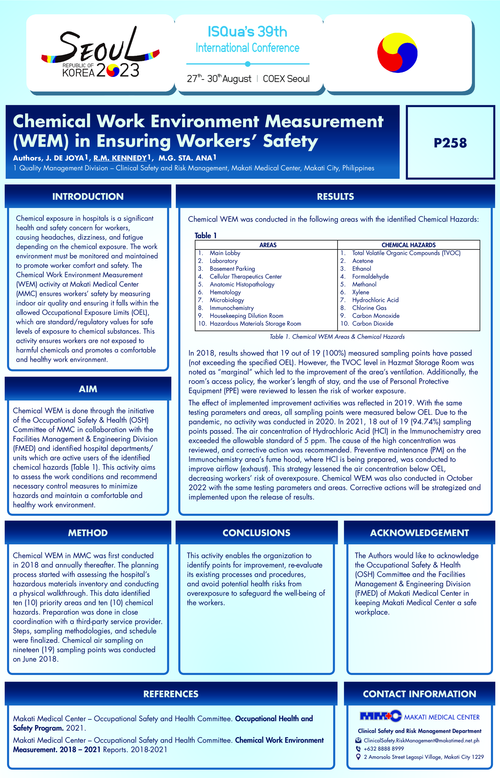
Chemical exposure in the hospital setting is often work-related and a significant health and safety concern for workers. Acute and chronic exposure to commonly used compounds such as formaldehyde and organic solvents may lead to severe health effects. Depending on the chemical exposure, this may cause headaches, dizziness, and fatigue, and effects may show up immediately after exposure or after repeated exposures. Hence, the work environment must be monitored, maintained, and controlled in comfortable and healthy conditions at all times to promote the health & safety of workers. The Chemical Work Environment Measurement (WEM) activity in Makati Medical Center (MMC) aims to ensure workers' safety through an indoor air quality measurement. This activity determines the concentration of chemical substances in the air and checks if it is within the allowed Occupational Exposure Limits. Occupational Exposure Limits (OEL) are standard/regulatory values that indicate workers' safe levels of exposure to a chemical substance in the air.
AIM: Chemical WEM is done through the initiative of the Occupational Safety & Health (OSH) Committee of MMC in collaboration with the Facilities Management & Engineering Division (FMED) and identified hospital departments/units which are active users of the identified chemical hazards (Table 1). This activity aims to assess the work conditions and recommend necessary control measures to minimize hazards and maintain a comfortable and healthy work environment.
- Methods
Chemical WEM in MMC was first conducted in 2018 and annually thereafter. The planning process started with the assessment of the hospital's hazardous materials inventory and the conduct of a physical walkthrough. Through this data, ten (10) priority areas and ten (10) chemical hazards were identified. Preparation was done in close coordination with a third-party service provider. Steps, sampling methodologies, and schedule were finalized. Chemical air sampling on nineteen (19) sampling points was conducted on June 2018.
Chemical WEM was conducted in the following areas with the identified Chemical Hazards:
AREAS
- Main Lobby
- Laboratory
- Basement Parking
- Cellular Therapeutics Center
- Anatomic Histopathology
- Hematology
- Microbiology
- Immunochemistry
- Housekeeping Dilution Room
- Hazardous Materials Storage Room
CHEMICAL HAZARDS
- Total Volatile Organic Compounds (TVOC)
- Acetone
- Ethanol
- Formaldehyde
- Methanol
- Xylene
- Hydrochloric Acid
- Chlorine Gas
- Carbon Monoxide
- Carbon Dioxide
- Results
In 2018, results showed that 19 out of 19 (100%) measured sampling points have passed (not exceeding the specified OEL). However, the TVOC level in Hazmat Storage Room was noted as "marginal" which led to the improvement of the area's ventilation. Additionally, the room's access policy, the worker's length of stay, and the use of Personal Protective Equipment (PPE) were reviewed to lessen the risk of worker's exposure.
The effect of implemented improvement activities was reflected in 2019. With the same testing parameters and areas, all sampling points were measured below OEL. Due to the pandemic, no activity was conducted in 2020. In 2021, 18 out of 19 (94.74%) sampling points passed. The air concentration of Hydrochloric Acid (HCl) in the Immunochemistry area exceeded the allowable standard of 5 ppm. The cause of the high concentration was reviewed, and corrective action was recommended. Preventive maintenance (PM) on the Immunochemistry area's fume hood, where HCl is being prepared, was conducted to improve airflow (exhaust). This strategy lessened the air concentration below OEL, decreasing workers' risk of overexposure. Chemical WEM was also conducted in October 2022 with the same testing parameters and areas. Corrective actions will be strategized and implemented upon the release of results.
- Conclusion
This activity enables the organization to identify points for improvement, re-evaluate its existing processes and procedures, and avoid potential health risks from overexposure to safeguard the well-being of the workers.