708 posters, 8 topics, 16 sessions, 1,190 authors, 600 institutions
ePostersLive by SciGen Technologies S.A. All rights reserved.
ISQua's 39th International Conference 2023
August 27 - 30, 2023 | Seoul, Republic of Korea

P254
PATIENT-RELATED INTERVENTIONS TO IMPROVE PATIENT SAFETY: FINDINGS BASED ON AN UMBRELLA REVIEW OF NON-CLINICAL INTERVENTIONS IN THE PERIOPERATIVE CARE PROCESS
Part of Topic
Patient Safety & Quality Improvement
PATIENT-RELATED INTERVENTIONS TO IMPROVE PATIENT SAFETY: AN UMBRELLA REVIEW OF NON-CLINICAL INTERVENTIONS IN THE PERIOPERATIVE CARE PROCESS
J. KOMMUSAAR1, A. HEIDEVELD-CHEVALKING2, J. PÜHVEL1, H. CALSBEEK3, M. KANGASNIEMI1, Y. EMOND3 and K. PÕLLUSTE4
1 Department of Nursing Science, Institute of Family Medicine and Public Health, Faculty of Medicine, University of Tartu, Tartu, Estonia
2 Department of Operating Theatres, Radboud university medical center, Nijmegen, The Netherlands
3 Scientific Center for Quality of Healthcare (IQ healthcare), Radboud Institute for Health Sciences, Nijmegen, The Netherlands
4 Department of Internal Medicine, Institute of Clinical Medicine, Faculty of Medicine, University of Tartu, Tartu, Estonia
Topic: Patient Safety and Quality Improvement, P254
INTRODUCTION
Approximately 10% of all patients admitted to hospitals experience adverse events1 and perioperative care is one of the most reported fields2. Adverse events have been found to cause patient complications and increased costs, highlighting the need for multiple types of interventions. We defined patient safety as the prevention of errors and adverse effects (e.g. undesired effects of a drug or other type of treatment, such as surgery) to patients. Non-clinical patient-safety interventions are described as interventions, strategies, practices, behaviour, actions, procedures, or structures which are aimed at improving safety.
AIM
To describe non-clinical specific patient-related interventions to improve patient safety practices in the perioperative care process.
METHOD
This study is part of a bigger umbrella review aiming to identify and assess the quality of non-clinical specific interventions to improve patient safety practices in the perioperative care process. We followed Aromataris et al.4 methodology guidance for umbrella reviews. PubMed, Scopus, CINAHL, PsycINFO, and Cochrane databases were searched for quantitative systematic reviews and meta-analyses on interventions to improve adult patients' safety in the perioperative care process. The inclusion criteria were: 1) published between 2012-2022; 2) involved one or more surgical sub-specialities; 3) adult patients; 4) we did not restrict language. The selection was carried out independently by two researchers. Disagreement was solved by discussion with the team. Two researchers independently extracted the data and evaluated the quality of studies with the JBI Critical Appraisal Checklist for Systematic Reviews and Research Synthesis4. The review protocol has been registered in PROSPERO (protocol number CRD42023397419).
RESULTS
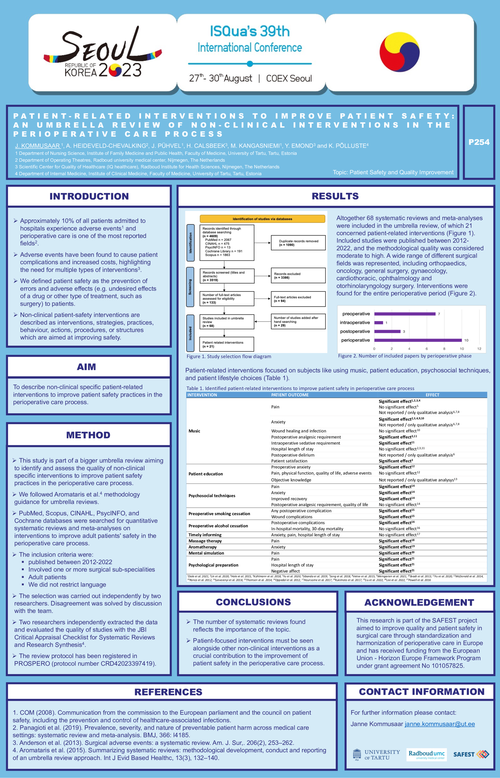
Altogether 68 systematic reviews and meta-analyses were included in the umbrella review, of which 21 concerned patient-related interventions. Included studies were published between 2012-2022, and the methodological quality was considered moderate to high. A wide range of different surgical fields was represented, including orthopaedics, oncology, general surgery, gynaecology, cardiothoracic, ophthalmology and otorhinolaryngology surgery. Interventions were found for the entire perioperative period. Patient-related interventions focused on subjects like using music, patient education, psychosocial techniques, and patient lifestyle choices.
CONCLUSIONS
The number of systematic reviews found reflects the importance of the topic. Patient-focused interventions must be seen alongside other non-clinical interventions as a crucial contribution to the improvement of patient safety in the perioperative care process.
ACKNOWLEDGEMENT
This research is part of the SAFEST project aimed to improve quality and patient safety in surgical care through standardization and harmonization of perioperative care in Europe and has received funding from the European Union - Horizon Europe Framework Program under grant agreement No 101057825.
REFERENCES
1. COM (2008). Communication from the commission to the European parliament and the council on patient safety, including the prevention and control of healthcare-associated infections.
2. Panagioti et al. (2019). Prevalence, severity, and nature of preventable patient harm across medical care settings: systematic review and meta-analysis. BMJ, 366: l4185.
3. Anderson et al. (2013). Surgical adverse events: a systematic review. Am. J. Sur,. 206(2), 253–262.
4. Aromataris et al. (2015). Summarizing systematic reviews: methodological development, conduct and reporting of an umbrella review approach. Int J Evid Based Healthc, 13(3), 132–140.
CONTACT INFORMATION
For further information please contact: Janne Kommusaar janne.kommusaar@ut.ee