708 posters, 8 topics, 16 sessions, 1,190 authors, 600 institutions
ePostersLive by SciGen Technologies S.A. All rights reserved.
ISQua's 39th International Conference 2023
August 27 - 30, 2023 | Seoul, Republic of Korea

P251
INFLUENCE OF PATIENT SAFETY CULTURE ON NURSES’ PATIENT SAFETY COMPLIANCE AND PARTICIPATION BEHAVIORS
Part of Topic
Patient Safety & Quality Improvement
Influence of Patient Safety Culture on Nurses’ Patient Safety Compliance and Participation Behaviors
J. J. Lee 1, H. Ji 1, S. E. Lee 2
1 Severance Hospital, Seoul, Republic of Korea
2 College of Nursing · Mo-Im Kim Nursing Research Institute, Yonsei University, Seoul, Republic of Korea
INTRODUCTION
•Nurses’ patient safety compliance and participation behaviors are vital for improving patient safety in healthcare organizations [1].
•Patient safety compliance behavior refers to safety behavior such as adhering safety guidelines and rules, while patient safety participation behavior involves extra safety activities that require voluntary participation for improving patient safety [2].
•Research has shown that safety culture is an identified important predictor for safety behaviors of workers in high-risk industry such as construction industry [3], however, the relationship has not been well examined in healthcare contexts [1].
•This study aimed to examine the effects of patient safety culture on nurses’ patient safety compliance and participation behaviors.
METHOD
•Design: Correlational, cross-sectional
•Sample: 913 nurses who provided direct care to patients in one acute hospital in Korea
•Independent variable: patient safety culture measured using the Korean version of the Hospital Survey on Patient Safety Culture 2.0 [4]
•Dependent variables: patient safety compliance and participation behaviors measured using relevant domains of the Safety Performance scale [5].
•Statistical analysis: multiple linear regressions
RESULT
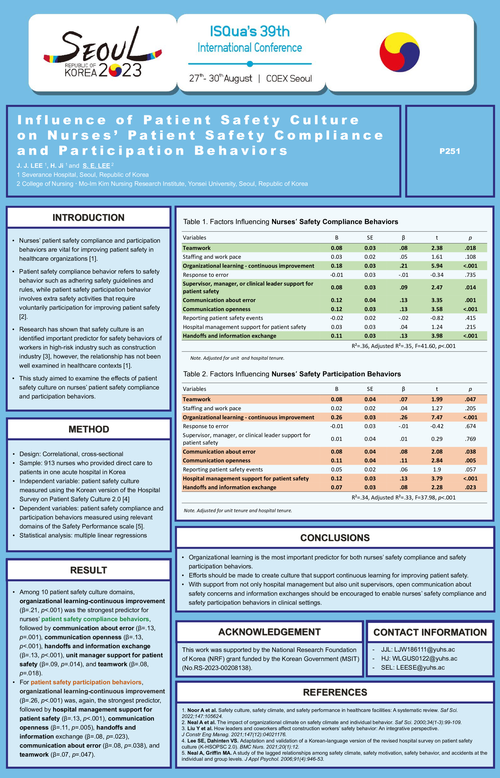
•Among 10 patient safety culture domains, organizational learning-continuous improvement (β=.21, p<.001) was the strongest predictor for nurses’ patient safety compliance behaviors, followed by communication about error (β=.13, p=.001), communication openness (β=.13, p<.001), handoffs and information exchange (β=.13, p<.001), unit manager support for patient safety (β=.09, p=.014), and teamwork (β=.08, p=.018).
•For patient safety participation behavior, organizational learning-continuous improvement (β=.26, p<.001) was, again, the strongest predictor, followed by hospital management support for patient safety (β=.13, p<.001), communication openness (β=.11, p=.005), handoffs and information exchange (β=.08, p=.023), communication about error (β=.08, p=.038), and teamwork (β=.07, p=.047).
CONCLUSIONS
•Organizational learning is the most important predictor for both nurses’ safety compliance and safety participation behaviors.
•Efforts should be made to create culture that support continuous learning for improving patient safety.
•With support from not only hospital management but also unit supervisors, open communication about safety concerns and information exchanges should be encouraged to enable nurses’ safety compliance and safety participation behaviors in clinical settings.