708 posters, 8 topics, 16 sessions, 1,190 authors, 600 institutions
ePostersLive by SciGen Technologies S.A. All rights reserved.
ISQua's 39th International Conference 2023
August 27 - 30, 2023 | Seoul, Republic of Korea

P243
OUTCOMES OF CABG QUALITY ASSESSMENT IN KOREA
Poster Presenter
Authors
Affiliations
Part of Topic
Patient Safety & Quality Improvement
INTRODUCTION
■ Heart disease is the third leading cause of death in OECD countries, accounting for 11%, and the second rank in Korea.
■ Although Percutaneous Coronary Intervention(PCI) is on the rise as a treatment for ischemic heart disease, Coronary Artery Bypass Grafting (CABG) is more recommended to cases of extensive coronary artery disease, decreased systolic function of left ventricle, or stenosis of left main branch of the coronary artery.
■ Accordingly, the quality assessment for CABG was introduced to encourage voluntary quality improvement in health-care institutions by measuring the quality level of care and providing results. The 1st assessment started in 2008- , and the results for the 8th assessment wererecently calculated.
AIM
■ The study aims to compare the result of CABG assessment collected from Health Insurance Review & Assessment service(HIRA) in South Korea.
METHOD
■ The target institution is general hospital and tertiary hospital, targeting hospitalized patients who underwent coronary artery bypass surgery due to ischemic heart disease(I20~I25).
■ The 9th assessment is in progress from October 2021 to September 2023. And the indicators are made up of 7 assessment indicators including ‘surgical volume of CABG’, ‘rate of CABG using IMA(Internal Mammary Artery)’ and 7 mornitoring indicators including ‘Rate of PCI before CABG’.
■ Among these indicators, risk-adjusted indicators which were developed fromrisk-adjustment models have been applied since the 1st assessment. And the model was improved in 2015 and 2019 respectively, increasing the accuracy.
RESULTS
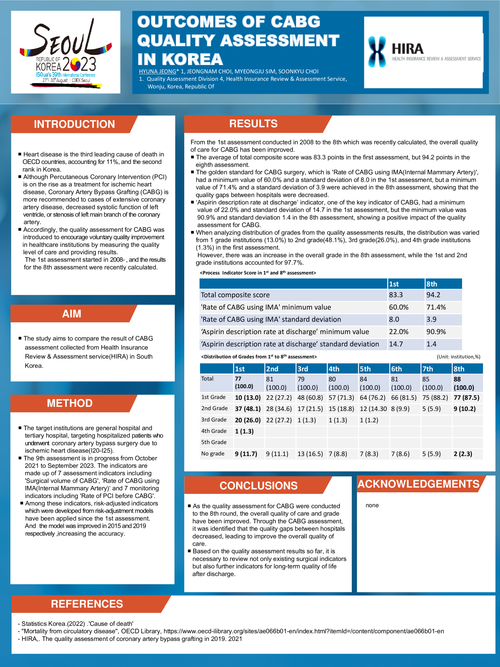
From the 1st assessment conducted in 2008 to the 8th, which was recently calculated, the overall quality of care for CABG has been improved.
■ The average of total composite score was 83.3 points in the first assessment, but 94.2 points in the eighth assessment.
■ The golden standard for CABG surgery, which is ‘rate of CABG using IMA(Internal Mammary Artery)’, had a minimum value of 60.0% and a standard deviation of 8.0 in the 1st assessment, but a minimum value of 71.4% and a standard deviation of 3.9 were achieved in the 8th assessment, showing that the quality gaps between hospitals were decreased.
■ ‘Aspirin description rate at discharge’indicator, one of the key indicator of CABG, had a minimum value of 22.0% and standard deviation of 14.7 in the 1st assessment, but the minimum value was 90.9% and standard deviation 1.4 in the 8th assessment, showing a positive impact of the quality assessment for CABG.
■ When analyzing distribution of grades from the quality assessments results, the distribution was varied from 1st grade institutions (13.0%) to 2nd grade(48.1%), 3rd grade(26.0%), and 4th grade instituions (1.3%) in the first assessment.However, there was an increase in the overall grade in the 8th assessment, while the 1st and 2nd grade institutions accounted for 97.7%.
CONCLUSIONS
■ As the quality assessment for CABG were conducted to the 8th round, the overall quality of care and grade have been improved. Through the CABG assessment, it was identified that the quality gaps between hospitals decreased, leading to improve the overall quality of care.
■ Based on the quality assessment results so far, it is necessary to review not only existing surgical indicators but also further indicators for long-term quality of life after discharge.
REFERENCES
- Statistics Korea.(2022) .'Cause of death'
- "Mortality from circulatory disease", OECD Library, https://www.oecd-ilibrary.org/sites/ae066b01-en/index.html?itemId=/content/component/ae066b01-en
- HIRA,. The quality assessment of coronary artery bypass grafting in 2019. 2021