708 posters, 8 topics, 16 sessions, 1,190 authors, 600 institutions
ePostersLive by SciGen Technologies S.A. All rights reserved.
ISQua's 39th International Conference 2023
August 27 - 30, 2023 | Seoul, Republic of Korea

P241
ANALYSIS OF TUBERCULOSIS MEDICAL QUALITY MANAGEMENT IN KOREA FOR FIVE YEARS: USING THE QUALITY ASSESSMENT(QA) PROGRAM
Poster Presenter
Authors
Affiliations
Part of Topic
Patient Safety & Quality Improvement
INTRODUCTION
The number of new tuberculosis(TB) patients in Korea has been on a steady decline since 2011 along with the government’s TB prevention and management policy, but it still ranks first in the incidence rate and third in mortality among OECD countries.
Accordingly, the government established the 2nd comprehensive TB control plan as part of the national project to reduce the incidence of TB to the level of developed countries, and introduced the quality assessment (QA) program of the Health Insurance Review and Assessment Service.
AIM
The study aims to examine the TB care according to the 4th QA in 2021, starting with the preliminary QA in 2017.
METHOD
1.Data source
From January to June of each year, patients with TB data was collected from Heath insurance Review&Assessment Service(HIRA) claim data and new patients with TB data from Korea Centers for Disease Control and Prevention Agency(KCDA).
2. The QA program indicators
Started with 6 indicators: Performance rate of acid-fast bacilli smear, Performance rate of acid-fast bacilli culture, Performance rate of M.tuberculosis-polymerase chain reaction, Compliance rate of treatment regimen, Physician visit of TB patient, Days of medicine prescription
Introduced 2 indicators: Performance rate of drug susceptibility test and Performance rate of rapid-drug susceptibility test were sequentially induced in 3rd and 4th evalutions as the importance of managing drug-resistant TB.
3. Statistical analysis
All statistical analysis were performed using SAS Enterprise Guide 7.1.
RESULTS
1. Tuberculosis patients
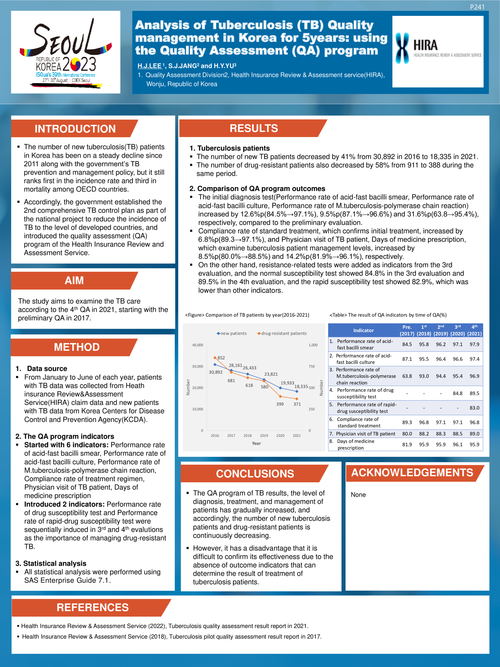
The number of new TB patients decreased by 41% from 30,892 in 2016 to 18,335 in 2021. The number of drug-resistant patients also decreased by 58% from 911 to 388 during the same period.
2. Comparison of QA program outcomes
The initial diagnosis test(Performance rate of acid-fast bacilli smear, Performance rate of acid-fast bacilli culture, Performance rate of M.tuberculosis-polymerase chain reaction) increased by 12.6%p(84.5%→97.1%), 9.5%p(87.1%→96.6%) and 31.6%p(63.8→95.4%), respectively, compared to the preliminary evaluation.
Compliance rate of standard treatment, which confirms initial treatment, increased by 6.8%p(89.3→97.1%), and Physician visit of TB patient, Days of medicine prescription, which examine tuberculosis patient management levels, increased by 8.5%p(80.0%→88.5%) and 14.2%p(81.9%→96.1%), respectively.
On the other hand, resistance-related tests were added as indicators from the 3rd evaluation, and the normal susceptibility test showed 84.8% in the 3rd evaluation and 89.5% in the 4th evaluation, and the rapid susceptibility test showed 82.9%, which was lower than other indicators.
CONCLUSIONS
The QA program of TB results, the level of diagnosis, treatment, and management of patients has gradually increased, and accordingly, the number of new tuberculosis patients and drug-resistant patients is continuously decreasing.
However, it has a disadvantage that it is difficult to confirm its effectiveness due to the absence of outcome indicators that can determine the result of treatment of tuberculosis patients.
ACKNOWLEDGEMENT
None.
REFERENCES
Health Insurance Review & Assessment Service (2022), Tuberculosis quality assessment result report in 2021.
Health Insurance Review & Assessment Service (2018), Tuberculosis pilot quality assessment result report in 2017.