708 posters, 8 topics, 16 sessions, 1,190 authors, 600 institutions
ePostersLive by SciGen Technologies S.A. All rights reserved.
ISQua's 39th International Conference 2023
August 27 - 30, 2023 | Seoul, Republic of Korea

P238
Deriving criteria weights for acute care hospital accreditation in South Korea: using the analytic hierarchy process
Poster Presenter
Authors
Affiliations
Part of Topic
Patient Safety & Quality Improvement
Deriving criteria weights for acute care hospital accreditation in South Korea: using analytic hierarchy process
Hwa-Yeong Oh 1 , Hyeon-Jeong Lee 1 , Ji-Eun Choi 1 , Minsu Ock 2 , In-Ho Kim 1 , Ho-Yeol Jang 1 , Sukyeong Kim 3 , Jeehee Pyo 2 , Danbi Cho 4
1 National Evidence-based Healthcare Collaborating Agency, Seoul, 2 Ulsan Public Health policy Institue, Ulsan, 3 Korean Pharmaceutical Association, 4 Department of Medical Law and Bioethics, Yonsei University, Seoul, Republic of Korea
○ INTRODUCTION
The acute hospital accreditation program launched in South Korea will carry out 4th cycle in 2023 and has shown positive effect on safety culture and quality of care. However, advancement of accreditation standards are needed to provide consumers with more useful information and to stimulate performance improvement. Regarding accreditation standards with a hierarchical structure, the relative weights have not been investigated so far.
○ AIM
This study aimed to derive the relative weights of acute care hospital accreditation standards.
○ METHODS
We conducted an online survey using an analytic hierarchy process(AHP) technique in terms of validity, importance, and urgency. If the weight is the same in each pair, 1 point is given, and if a greater weight is given to one side, the weight is given from 2 to 9 for that item.
The accreditation criteria for acute hospital have a four-level hierarchical structure including domain level, chapter level, standard level, and measurable element level omitted in Fig. 1. The pairwise comparison for AHP was used to calculate the weights of 4 domain categories and 5 chapters among the ‘patient care system’ domain and 6 chapters among the ‘organizational management system’ domain respectively. The ‘basic value system’ and the ‘performance management system’ domain has only one chapter, pairwise comparison was not performed.
The AHP online survey link was sent in November 2022 based on informed consent to 10 experts on hospital accreditation. This study was approved by the Research Ethics Review Committee of the National Evidence-based Healthcare Collaborating Agency (Approval No. NECAIRB 22-019).
○ RESULTS
The respondents consisted of 60% female, and the majority of respondents were in the age group of 50-59 years, and worked at private acute hospitals. Half of the respondents majored in medicine, and the rest in nursing.
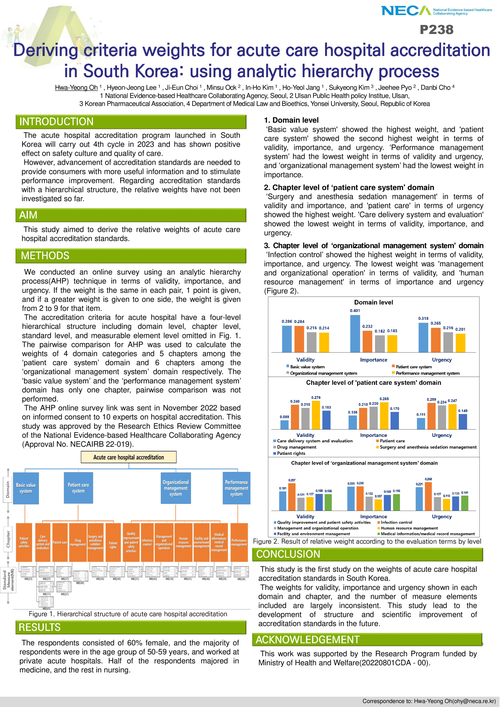
1. Domain level
‘Basic value system' showed the highest weight, and 'patient care system' showed the second highest weight in terms of validity, importance, and urgency. ‘Performance management system’ had the lowest weight in terms of validity and urgency, and ‘organizational management system’ had the lowest weight in importance.
2. Chapter level of ‘patient care system' domain
‘Surgery and anesthesia sedation management' in terms of validity and importance, and 'patient care' in terms of urgency showed the highest weight. 'Care delivery system and evaluation' showed the lowest weight in terms of validity, importance, and urgency.
3. Chapter level of ‘organizational management system’ domain
‘Infection control’ showed the highest weight in terms of validity, importance, and urgency. The lowest weight was 'management and organizational operation' in terms of validity, and 'human resource management' in terms of importance and urgency (Figure 2).
○ CONCLUSION
This study is the first study on the weights of acute care hospital accreditation standards in South Korea.
The weights for validity, importance and urgency shown in each domain and chapter, and the number of measure elements included are largely inconsistent. This study lead to the development of structure and scientific improvement of accreditation standards in the future.
○ ACKNOWLEDGEMENT
This work was supported by the Research Program funded by Ministry of Health and Welfare(20220801CDA - 00).