708 posters, 8 topics, 16 sessions, 1,190 authors, 600 institutions
ePostersLive by SciGen Technologies S.A. All rights reserved.
ISQua's 39th International Conference 2023
August 27 - 30, 2023 | Seoul, Republic of Korea

P236
USING MULTIPLE CUSTOMIZATION STRATEGIES TO REDUCE THE INCIDENCE OF FALLS AMONG PATIENTS IN A DISTRICT HOSPITAL
Poster Presenter
Authors
Hui-Yun Chang, Mei-Fei Ko, Hui-Chu Lee, Shih-Sheng Chang, Ta-Sen Yeh
Affiliations
Part of Topic
Patient Safety & Quality Improvement
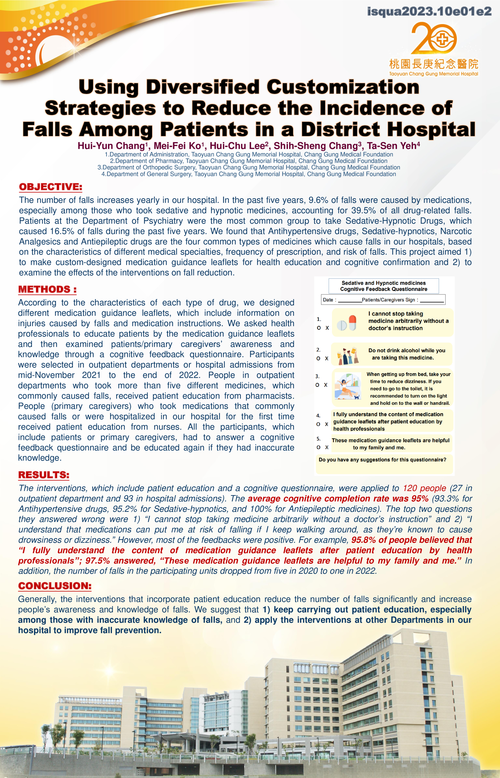
Objective: The number of falls increases yearly in our hospital. In the past five years, 9.6% of falls were caused by medications, especially among those who took sedative and hypnotic medicines, accounting for 39.5% of all drug-related falls. Patients at the Department of Psychiatry were the most common group to take Sedative-Hypnotic Drugs, which caused 16.5% of falls during the past five years. We found that Antihypertensive drugs, Sedative-hypnotics, Narcotic Analgesics and Antiepileptic drugs are the four common types of medicines which cause falls in our hospitals, based on the characteristics of different medical specialties, frequency of prescription, and risk of falls. This project aimed 1) to make custom-designed medication guidance leaflets for health education and cognitive confirmation and 2) to examine the effects of the interventions on fall reduction.
Methods: According to the characteristics of each type of drug, we designed different medication guidance leaflets, which include information on injuries caused by falls and medication instructions. We asked health professionals to educate patients by the medication guidance leaflets and then examined patients/primary caregivers’ awareness and knowledge through a cognitive feedback questionnaire. Participants were selected in outpatient departments or hospital admissions from mid-November 2021 to the end of 2022. People in outpatient departments who took more than five different medicines, which commonly caused falls, received patient education from pharmacists. People (primary caregivers) who took medications that commonly caused falls or were hospitalized in our hospital for the first time received patient education from nurses. All the participants, which include patients or primary caregivers, had to answer a cognitive feedback questionnaire and be educated again if they had inaccurate knowledge.
Results: The interventions, which include patient education and a cognitive questionnaire, were applied to 120 people (27 in outpatient department and 93 in hospital admissions). The average cognitive completion rate was 95% (93.3% for Antihypertensive drugs, 95.2% for Sedative-hypnotics, and 100% for Antiepileptic medicines). The top two questions they answered wrong were 1) “I cannot stop taking medicine arbitrarily without a doctor’s instruction” and 2) “I understand that medications can put me at risk of falling if I keep walking around, as they’re known to cause drowsiness or dizziness.” However, most of the feedbacks were positive. For example, 95.8% of people believed that “I fully understand the content of medication guidance leaflets after patient education by health professionals”; 97.5% answered, “These medication guidance leaflets are helpful to my family and me.” In addition, the number of falls in the participating units dropped from five in 2020 to one in 2022.
Conclusion: Generally, the interventions that incorporate patient education reduce the number of falls significantly and increase people’s awareness and knowledge of falls. We suggest that 1) keep carrying out patient education, especially among those with inaccurate knowledge of falls, and 2) apply the interventions at other Departments in our hospital to improve fall prevention.
Keywords: Polypharmacy, Drug-related falls, Cognition of Falls Health Education