708 posters, 8 topics, 16 sessions, 1,190 authors, 600 institutions
ePostersLive by SciGen Technologies S.A. All rights reserved.
ISQua's 39th International Conference 2023
August 27 - 30, 2023 | Seoul, Republic of Korea

P228
THE IMPROVEMENT PLAN FOR THE REDUCE UNPLANNED REHOSPITALIZATION OF THE HEPATIC ENCEPHALOPATHY PATIENTS
Poster Presenter
Authors
Hui-Ling CHO, Ya-Hui Kao, Chu-Kuang Chou, Wei-Li Tseng, Yi-Lin Chen, Chun-Nan Chou
Affiliations
Ditmanson Medical Foundation Chia-Yi Christina Hospital, Department of Nursing, Ditmanson Medical Foundation Chia-Yi Christina Hospital, Division of Hepatogastroenterology, Ditmanson Medical Foundation Chia-Yi Christina Hospital, Center for Quality Management, Ditmanson Medical Foundation Chia-Yi Christian Hospital
Part of Topic
Patient Safety & Quality Improvement
Title
The improvement plan for the reduce unplanned rehospitalization of the hepatic encephalopathy patients
Introduction
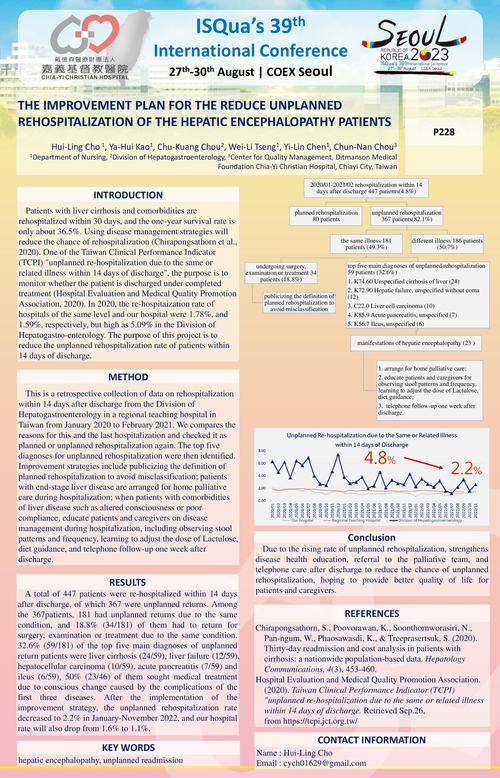
Patients with liver cirrhosis and comorbidities are rehospitalized within 30 days, and the one-year survival rate is only about 36.5%. Using disease management strategies will reduce the chance of rehospitalization (Chirapongsathorn et al., 2020). One of the Taiwan Clinical Performance Indicator (TCPI) "unplanned re-hospitalization due to the same or related illness within 14 days of discharge", the purpose is to monitor whether the patient is discharged under completed treatment. (Hospital Evaluation and Medical Quality Promotion Association, 2020). In 2020, the rehospitaization rate of hospitals of the same level and our hospital were 1.78%, and 1.59%, respectively, but high as 5.09% in the Division of Hepatogastroenterology. Therefore, the purpose of this project is to reduce the unplanned rehospitalization rate of patients within 14 days of discharge.
Method
This is a retrospective collection of data on rehospitalization within 14 days after discharge from the Division of Hepatogastroenterology in a regional teaching hospital in Taiwan from January 2020 to February 2021. We compares the reasons for this and the last hospitalization, and checked it as planned or unplanned rehospitalization again. The top five diagnoses for unplanned rehospitalization were then identified. Improvement strategies include publicizing the definition of planned rehospitalization to avoid misclassification; patients with end-stage liver disease are arrange for home palliative care during hospitalization; when patients with comorbidities of liver disease such as altered consciousness or poor compliance, educate patients and caregivers on disease management during hospitalization, including observing stool patterns and frequency, learning to adjust the dose of Lactulose, diet guidance, and telephone follow-up one week after discharge.
Results
A total of 447 patients were re-hospitalized within 14 days after discharge, of which 367 were unplanned returns. Among the 367patients, 181 had unplanned returns due to the same condition, and 18.8% (34/181) of them had to return for surgery, examination or treatment due to the same condition. 32.6% (59/181) of the top five main diagnoses of unplanned return patients were liver cirrhosis (24/59), liver failure (12/59), hepatocellular carcinoma (10/59), acute pancreatitis (7/59) and ileus (6/59), 50% (23/46) of them sought medical treatment due to conscious change caused by the complications of the first three diseases. After the implementation of the improvement strategy, the unplanned rehospitalization rate decreased to 2.2% in January-November 2022, and our hospital rate will also drop from 1.6% to 1.1%.
Conclusion
Due to the rising rate of unplanned rehospitalization, strengthens disease health education, referral to the palliative team, and telephone care after discharge to reduce the chance of unplanned rehospitalization, hoping to provide better quality of life for patients and caregivers.