708 posters, 8 topics, 16 sessions, 1,190 authors, 600 institutions
ePostersLive by SciGen Technologies S.A. All rights reserved.
ISQua's 39th International Conference 2023
August 27 - 30, 2023 | Seoul, Republic of Korea

P227
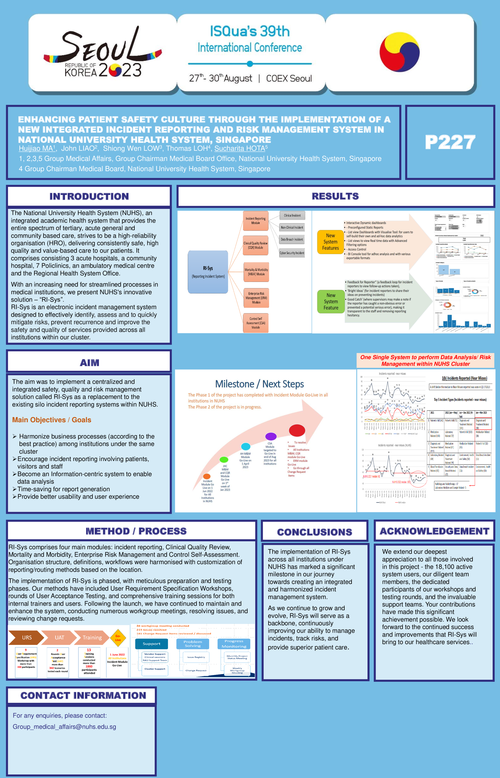
ENHANCING PATIENT SAFETY CULTURE THROUGH IMPLEMENTATION OF A NEW INTEGRATED INCIDENT REPORTING AND RISK MANAGEMENT SYSTEM IN NATIONAL UNIVERSITY HEALTH SYSTEM, SINGAPORE
Poster Presenter
Authors
Huijiao MA, Sucharita Hota, John Liao, Shiong Wen Low, Thomas Loh
Affiliations
Part of Topic
Patient Safety & Quality Improvement
ENHANCING PATIENT SAFETY CULTURE THROUGH THE IMPLEMENTATION OF A NEW INTEGRATED INCIDENT REPORTING AND RISK MANAGEMENT SYSTEM IN NATIONAL UNIVERSITY HEALTH SYSTEM, SINGAPORE
Huijiao MA1, John LIAO2, Shiong Wen LOW3, Thomas LOH4, Sucharita HOTA5
1, 2,3,5 Group Medical Affairs, Group Chairman Medical Board Office, National University Health System, Singapore
4 Group Chairman Medical Board, National University Health System, Singapore
INTRODUCTION
The National University Health System (NUHS), an integrated academic health system that provides the entire spectrum of tertiary, acute general and community based care, strives to be a high-reliability organisation (HRO), delivering consistently safe, high quality and value-based care to our patients. It comprises consisting 3 acute hospitals, a community hospital, 7 Policlinics, an ambulatory medical centre and the Regional Health System Office.
With an increasing need for streamlined processes in medical institutions, we present NUHS's innovative solution – “RI-Sys”.
RI-Sys is an electronic incident management system designed to effectively identify, assess and to quickly mitigate risks, prevent recurrence and improve the safety and quality of services provided across all institutions within our cluster.
AIM
The aim was to implement a centralized and integrated safety, quality and risk management solution called RI-Sys as a replacement to the existing silo incident reporting systems within NUHS.
Main Objectives / Goals
METHOD / PROCESS
RI-Sys comprises four main modules: incident reporting, Clinical Quality Review, Mortality and Morbidity, Enterprise Risk Management and Control Self-Assessment. Organisation structure, definitions, workflows were harmonised with customization of reporting/routing methods based on the location.
The implementation of RI-Sys is phased, with meticulous preparation and testing phases. Our methods have included User Requirement Specification Workshops, rounds of User Acceptance Testing, and comprehensive training sessions for both internal trainers and users. Following the launch, we have continued to maintain and enhance the system, conducting numerous workgroup meetings, resolving issues, and reviewing change requests.
CONCLUSIONS
The implementation of RI-Sys across all institutions under NUHS has marked a significant milestone in our journey towards creating an integrated and harmonized incident management system.
As we continue to grow and evolve, RI-Sys will serve as a backbone, continuously improving our ability to manage incidents, track risks, and provide superior patient care.
ACKNOWLEDGEMENT
We extend our deepest appreciation to all those involved in this project - the 18,100 active system users, our diligent team members, the dedicated participants of our workshops and testing rounds, and the invaluable support teams. Your contributions have made this significant achievement possible. We look forward to the continued success and improvements that RI-Sys will bring to our healthcare services..
CONTACT INFORMATION
For any enquiries, please contact:
Group_medical_affairs@nuhs.edu.sg