708 posters, 8 topics, 16 sessions, 1,190 authors, 600 institutions
ePostersLive by SciGen Technologies S.A. All rights reserved.
ISQua's 39th International Conference 2023
August 27 - 30, 2023 | Seoul, Republic of Korea

ISQUA2023-ABS-3188
COMPARISON OF LONG-TERM OUTCOMES IN PATIENTS AFTER ACUTE MYOCARDIAL INFARCTION WITH AND WITHOUT OUT-OF-HOSPITAL CARDIAC ARREST – A NATIONWIDE-BASE STUDY
Poster Presenter
Authors
Affiliations
Part of Topic
Patient Safety & Quality Improvement
COMPARISON OF LONG-TERM OUTCOMES IN PATIENTS AFTER ACUTE MYOCARDIAL INFARCTION WITHAND WITHOUT OUT-OF-HOSPITAL CARDIAC ARREST – A NATIONWIDE-BASE STUDY
Hung-Chou Yang* 1, Wei-Chun Huang1, Wang-Chuan Juang1
1. Kaohsiung Veterans General Hospital, Kaohsiung, Taiwan
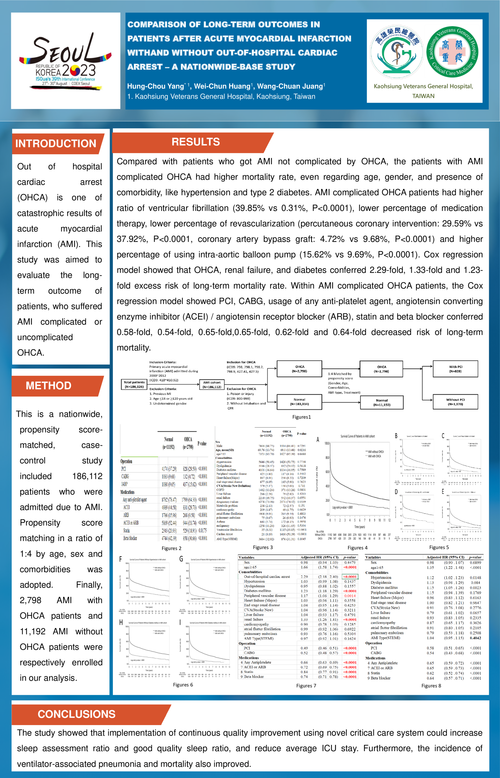
Introduction:Out of hospital cardiac arrest (OHCA) is one of catastrophic results of acute myocardial
infarction (AMI). This study was aimed to evaluate the long-term outcome of patients, who suffered AMI complicated or
uncomplicated OHCA.
Methods: This is a nationwide, propensity score-matched, case-control study included 186,112 patients who
were admitted due to AMI. Propensity score matching in a ratio of 1:4 by age, sex and comorbidities was adopted.
Finally, 2,798 AMI with OHCA patients and 11,192 AMI without OHCA patients were respectively enrolled in our analysis.
Results: Result: Compared with patients who got AMI not complicated by OHCA, the patients with AMI complicated
OHCA had higher mortality rate, even regarding age, gender, and presence of comorbidity, like hypertension and type 2
diabetes. AMI complicated OHCA patients had higher ratio of ventricular fibrillation (39.85% vs 0.31%, P<0.0001), lower
percentage of medication therapy, lower percentage of revascularization (percutaneous coronary intervention: 29.59% vs
37.92%, P<0.0001, coronary artery bypass graft: 4.72% vs 9.68%, P<0.0001) and higher percentage of using intra-aortic
balloon pump (15.62% vs 9.69%, P<0.0001). Cox regression model showed that OHCA, renal failure, and diabetes
conferred 2.29-fold, 1.33-fold and 1.23-fold excess risk of long-term mortality rate. Within AMI complicated OHCA
patients, the Cox regression model showed PCI, CABG, usage of any anti-platelet agent, angiotensin converting enzyme
inhibitor (ACEI) / angiotensin receptor blocker (ARB), statin and beta blocker conferred 0.58-fold, 0.54-fold, 0.65-fold,
0.65-fold, 0.62-fold and 0.64-fold decreased risk of long-term mortality.
Conclusion: This study demonstrated that first AMI patients complicated OHCA have higher mortality rate
than the patients without OHCA. PCI, CABG, usage of any anti-platelet, ACEI/ARB, statin and beta blocker have impact
of decreased risk of long-term mortality in AMI complicated with OHCA patients.