708 posters, 8 topics, 16 sessions, 1,190 authors, 600 institutions
ePostersLive by SciGen Technologies S.A. All rights reserved.
ISQua's 39th International Conference 2023
August 27 - 30, 2023 | Seoul, Republic of Korea

P211
THE EFFECT OF GERIATRIC SIMULATION GAMES ON IMPROVING FALLS AMONG OLDER ADULTS IN EMERGENCY DEPARTMENT
Poster Presenter
Authors
Affiliations
Part of Topic
Patient Safety & Quality Improvement
THE EFFECT OF GERIATRIC SIMULATION GAMES ON IMPROVING FALLS AMONG OLDER ADULTS IN EMERGENCY DEPARTMENT
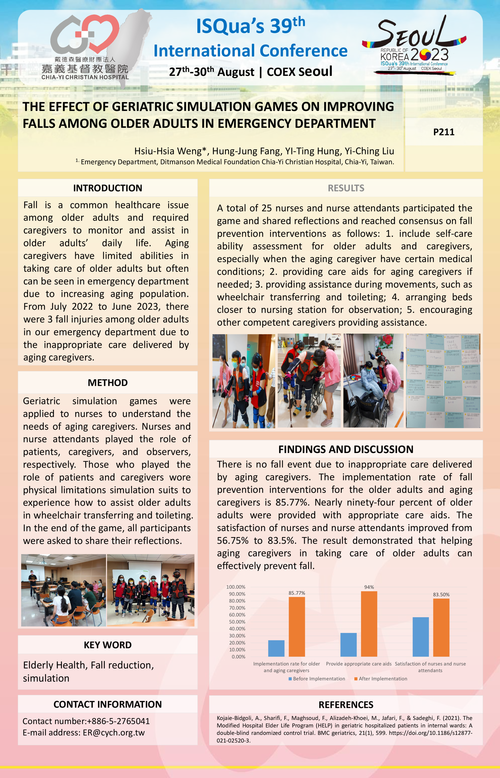
Introduction: Fall is a common healthcare issue among older adults and required caregivers to monitor and assist in older adults’ daily life. Aging caregivers have limited abilities in taking care of older adults but often can be seen in emergency department due to increasing aging population. From July 2022 to June 2023, there were 3 fall injuries among older adults in our emergency department due to the inappropriate care delivered by aging caregivers.
Methods: Geriatric simulation games were applied to nurses to understand the needs of aging caregivers. Nurses and nurse attendants played the role of patients, caregivers, and observers, respectively. Those who played the role of patients and caregivers wore physical limitations simulation suits to experience how to assist older adults in wheelchair transferring and toileting. In the end of the game, all participants were asked to share their reflections.
Results: A total of 25 nurses and nurse attendants participated the game and shared reflections and reached consensus on fall prevention interventions as follows: 1. include self-care ability assessment for older adults and caregivers, especially when the aging caregiver have certain medical conditions; 2. providing care aids for aging caregivers if needed; 3. providing assistance during movements, such as wheelchair transferring and toileting; 4. arranging beds closer to nursing station for observation; 5. encouraging other competent caregivers providing assistance.
Conclusion: There is no fall event due to inappropriate care delivered by aging caregivers. The implementation rate of fall prevention interventions for the older adults and aging caregivers is 85.77%. Nearly ninety-four percent of older adults were provided with appropriate care aids. The satisfaction of nurses and nurse attendants improved from 56.75% to 83.5%. The result demonstrated that helping aging caregivers in taking care of older adults can effectively prevent fall.