708 posters, 8 topics, 16 sessions, 1,190 authors, 600 institutions
ePostersLive by SciGen Technologies S.A. All rights reserved.
ISQua's 39th International Conference 2023
August 27 - 30, 2023 | Seoul, Republic of Korea

P192
ESTABLISHMENT OF PATIENT ADVOCATE AND CONSULTATION SERVICES BY LOCAL GOVERNMENTS TO PROMOTE PATIENT SAFETY; EFFORTS IN JAPAN
Part of Topic
Patient Safety & Quality Improvement
Establishment of patient advocate and consultation services by local governments to promote patient safety; efforts in Japan
Introduction
Patient engagement is an important part of measures to promote patient safety, and the WHO's Global action plan 2021-2030 also identifies patient and family engagement as a foundation to support the vision of “A world in which no one is harmed in health care"(1).
Patient advocacy and consultation are measures to achieve patient engagement, and services are offered in various forms in countries that are committed to universal health coverage(2,3).
In Japan, a patient advocate and consultation service has been operated by local governments since 2003 to promote medical safety.
The establishment of patient safety support centers that provide this service is obligatory by law, but all of 47 prefectures and public health centers in 110 major cities have established such centers.
Patient safety support centers play an important role in providing medical consultations to patients and their families.
AIM
To describe the number of consultation cases and their content in the 47 prefectures of Japan over the past five years.
Method
We used publicly available data from an annual complete survey on the operation status conducted by the Japan Society for Healthcare Quality and Safety, commissioned by the Ministry of Health, Labourand Welfare.
Data on the number of consultations at the 47 prefectural centers were analyzed.
Trends in the number of consultations and their content in each prefecture from April 2016 to March 2021 were examined.
R was used for statistical analysis.
For review by the Ethics Committee, consultation was conducted with the Ethics Committee of the University of Yamanashi, and it was determined that ethics review was not required.
Results
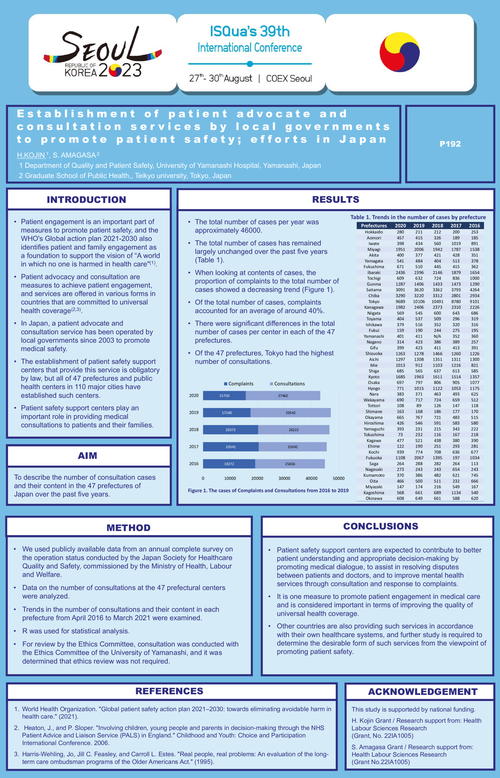
The total number of cases per year was approximately 46000.
The total number of cases has remained largely unchanged over the past five years (Table 1).
When looking at contents of cases, the proportion of complaints to the total number of cases showed a decreasing trend (Figure 1).
Of the total number of cases, complaints accounted for an average of around 40%.
There were significant differences in the total number of cases per center in each of the 47 prefectures.
Of the 47 prefectures, Tokyo had the highest number of consultations.
Conclusions
Patient safety support centers are expected to contribute to better patient understanding and appropriate decision-making by promoting medical dialogue, to assist in resolving disputes between patients and doctors, and to improve mental health services through consultation and response to complaints.
It is one measure to promote patient engagement in medical care and is considered important in terms of improving the quality of universal health coverage.
Other countries are also providing such services in accordance with their own healthcare systems, and further study is required to determine the desirable form of such services from the viewpoint of promoting patient safety.
References
1.World Health Organization. "Global patient safety action plan 2021–2030: towards eliminating avoidable harm in health care." (2021).
2.Heaton, J., and P. Sloper. "Involving children, young people and parents in decision-making through the NHS Patient Advice and Liaison Service (PALS) in England." Childhood and Youth: Choice and Participation International Conference. 2006.
3.Harris-Wehling, Jo, Jill C. Feasley, and Carroll L. Estes. "Real people, real problems: An evaluation of the long-term care ombudsman programs of the Older Americans Act." (1995).
Acknowlegement
This study is supportedd by national funding.
H. Kojin Grant / Research support from: Health LabourSciences Research (Grant, No. 22IA1005)
S. Amagasa Grant / Research support from: Health LabourSciences Research (Grant No.22IA1005)