708 posters, 8 topics, 16 sessions, 1,190 authors, 600 institutions
ePostersLive by SciGen Technologies S.A. All rights reserved.
ISQua's 39th International Conference 2023
August 27 - 30, 2023 | Seoul, Republic of Korea

P188
IMPLEMENTATION ANALYSIS TO IDENTIFY BARRIERS AND FACILITATORS IN LOW-INCOME COUNTRIES FOR THE INTRODUCTION OF PATIENT SAFETY MEASURES USING THE EXAMPLE OF MALAWI
Poster Presenter
Authors
Affiliations
Part of Topic
Patient Safety & Quality Improvement
Implementation analysis to identify barriers and facilitators in low-income countries for the introduction of patient safety measures using the example of Malawi
Hannah Rösner1, Mercy Katantha2, Victoria Klemm1, Reinhard Strametz1
1RheinMain University of Applied Science, Wiesbaden, Germany
2 Kamuzu Central Hospital, Lilongwe, Malawi
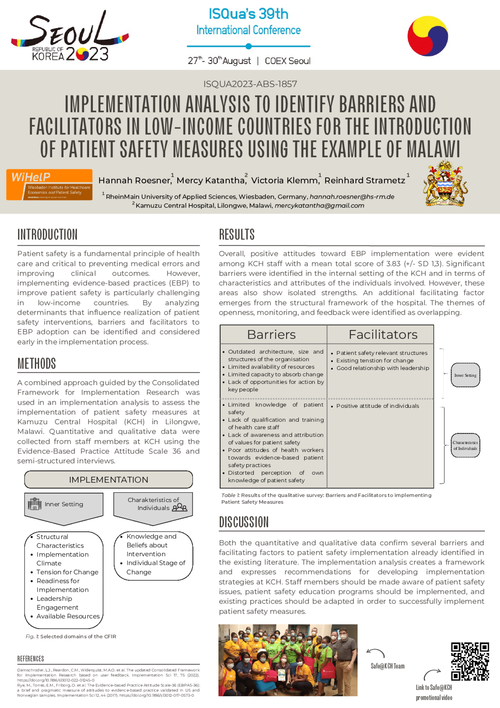
Background: Patient safety is a fundamental principle of health care and critical to preventing medical errors and improving clinical outcomes. However, implementing evidence-based practices (EBP) to improve patient safety is particularly challenging in low-income countries. By analyzing determinants that influence realization of patient safety interventions, barriers and facilitators to EBP adoption can be identified and considered early in the implementation process.
Methods: A combined approach guided by the Consolidated Framework for Implementation Research was used in an implementation analysis to assess the implementation of patient safety measures at Kamuzu Central Hospital (KCH) in Lilongwe, Malawi. Quantitative and qualitative data were collected from staff members at KCH using the Evidence-Based Practice Attitude Scale 36 and semi-structured interviews.
Results: Overall, positive attitudes toward EBP implementation were evident among KCH staff with a mean total score of 3.83 (+/- SD 1,3). Significant barriers were identified in the internal setting of the KCH and in terms of characteristics and attributes of the individuals involved. However, these areas also show isolated strengths. An additional facilitating factor emerges from the structural framework of the hospital. The themes of openness, monitoring, and feedback were identified as overlapping.
Discussion: Both the quantitative and qualitative data confirm several barriers and facilitating factors to patient safety implementation already identified in the existing literature. The implementation analysis creates a framework and expresses recommendations for developing implementation strategies at KCH. Staff members should be made aware of patient safety issues, patient safety education programs should be implemented, and existing practices should be adapted in order to successfully implement patient safety measures.