708 posters, 8 topics, 16 sessions, 1,190 authors, 600 institutions
ePostersLive by SciGen Technologies S.A. All rights reserved.
ISQua's 39th International Conference 2023
August 27 - 30, 2023 | Seoul, Republic of Korea

P186
COMPARISON OF NURSING STAFFING RATIO AT SAFETY-NET AND NON–SAFETY-NET HOSPITALS USING AREA HEALTH RESOURCE FILE AND AMERICAN HOSPITAL ASSOCIATION DATA
Poster Presenter
Authors
Affiliations
Part of Topic
Patient Safety & Quality Improvement
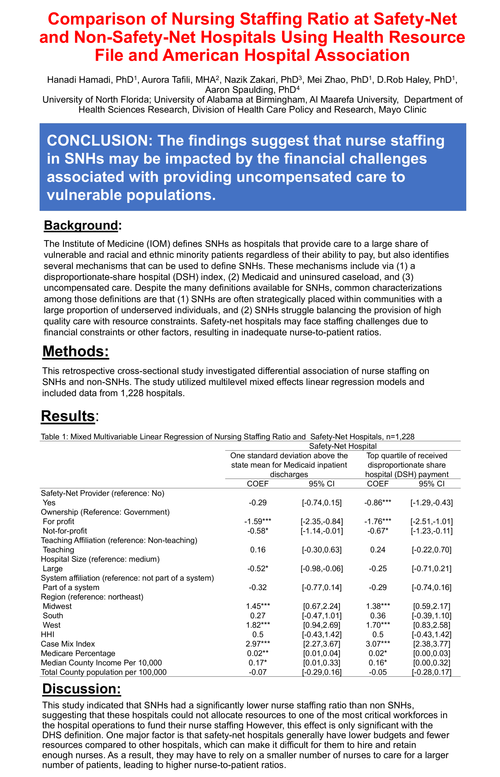
CONCLUSION: The findings suggest that nurse staffing in SNHs may be impacted by the financial challenges associated with providing uncompensated care to vulnerable populations.
Background:
The Institute of Medicine (IOM) defines SNHs as hospitals that provide care to a large share of vulnerable and racial and ethnic minority patients regardless of their ability to pay, but also identifies several mechanisms that can be used to define SNHs. These mechanisms include via (1) a disproportionate-share hospital (DSH) index, (2) Medicaid and uninsured caseload, and (3) uncompensated care. Despite the many definitions available for SNHs, common characterizations among those definitions are that (1) SNHs are often strategically placed within communities with a large proportion of underserved individuals, and (2) SNHs struggle balancing the provision of high quality care with resource constraints. Safety-net hospitals may face staffing challenges due to financial constraints or other factors, resulting in inadequate nurse-to-patient ratios.
Methods:
This retrospective cross-sectional study investigated differential association of nurse staffing on SNHs and non-SNHs. The study utilized multilevel mixed effects linear regression models and included data from 1,228 hospitals.
Discussion:
This study indicated that SNHs had a significantly lower nurse staffing ratio than non SNHs, suggesting that these hospitals could not allocate resources to one of the most critical workforces in the hospital operations to fund their nurse staffing However, this effect is only significant with the DHS definition. One major factor is that safety-net hospitals generally have lower budgets and fewer resources compared to other hospitals, which can make it difficult for them to hire and retain enough nurses. As a result, they may have to rely on a smaller number of nurses to care for a larger number of patients, leading to higher nurse-to-patient ratios.