708 posters, 8 topics, 16 sessions, 1,190 authors, 600 institutions
ePostersLive by SciGen Technologies S.A. All rights reserved.
ISQua's 39th International Conference 2023
August 27 - 30, 2023 | Seoul, Republic of Korea

ISQUA2023-ABS-2038
CANCER PATIENT DIAGNOSIS EXPERIENCE AND CARE QUALITY
Poster Presenter
Authors
Syeda Owais, Gaston Arnolda, Klay Lamprell, Romika Patel, Jeffrey Braithwaite
Affiliations
Part of Topic
Patient Safety & Quality Improvement
CANCER PATIENT DIAGNOSIS EXPERIENCE AND CARE QUALITY
Syeda OWAIS1, Gaston ARNOLDA1, Klay LAMPRELL1, Romika PATEL1, Jeffrey BRAITHWAITE1
1Australian Institute of Health Innovation , Macquarie University, Sydney, Australia
INTRODUCTION
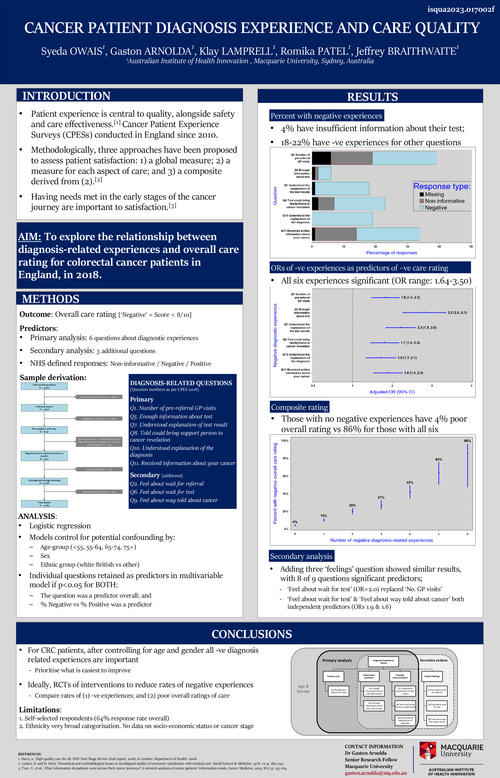
AIM: To explore the relationship between diagnosis-related experiences and overall care rating for colorectal cancer patients in England, in 2018.
METHODS
Outcome: Overall care rating [‘Negative’ = Score < 8/10]
Predictors:
DIAGNOSIS-RELATED QUESTIONS
[Question numbers as per CPES 2018]
Primary
Q1. Number of pre-referral GP visits
Q5. Enough information about test
Q7. Understood explanation of test result
Q8. Told could bring support person to cancer revelation
Q10. Understood explanation of the diagnosis
Q11. Received information about your cancer
Secondary [additional]
Q2. Feel about wait for referral
Q6. Feel about wait for test
Q9. Feel about way told about cancer
ANALYSIS:
Percent with negative experiences
ORs of -ve experiences as predictors of –ve care rating
•All six experiences significant (OR range: 1.64-3.50)
Composite rating
Secondary analysis
CONCLUSIONS
•For CRC patients, after controlling for age and gender all -ve diagnosis related experiences are important
Limitations:
1. Self-selected respondents (64% response rate overall)
2. Ethnicity very broad categorisation. No data on socio-economic status or cancer stage
REFERENCES:
1. Darzi, A., High quality care for all: NHS Next Stage Review final report, 2008, in London: Department of Health. 2008.
2. Locker, D. and D. Dunt, Theoretical and methodological issues in sociological studies of consumer satisfaction with medical care. Social Science & Medicine, 1978. 12: p. 283-292.
3. Tran, Y., et al., What information do patients want across their cancer journeys? A network analysis of cancer patients’ information needs. Cancer Medicine, 2019. 8(1): p. 155-164.