708 posters, 8 topics, 16 sessions, 1,190 authors, 600 institutions
ePostersLive by SciGen Technologies S.A. All rights reserved.
ISQua's 39th International Conference 2023
August 27 - 30, 2023 | Seoul, Republic of Korea

P181
REDUCING EARLY MORNING BLOOD ORDERS WITH THE USE OF DECISION MATRIX
Poster Presenter
Part of Topic
Patient Safety & Quality Improvement
PROJECT BACKGROUND
Concerns were raised during Nursing Dialogue Session in Changi General Hospital (CGH) on October 2020 regarding the early morning blood tests orders from 4am to 6am. Traditionally, early morning blood draws aim to have the results ready by 0800hrs for clinicians to make important decisions including discharging patients within the cut off time. Data shows the bulk of early morning blood draws include bloods for routine trending purposes. High volume of early morning blood draws can adversely impact patient care due to sleep disruption and nurses time taken away from direct patient care:
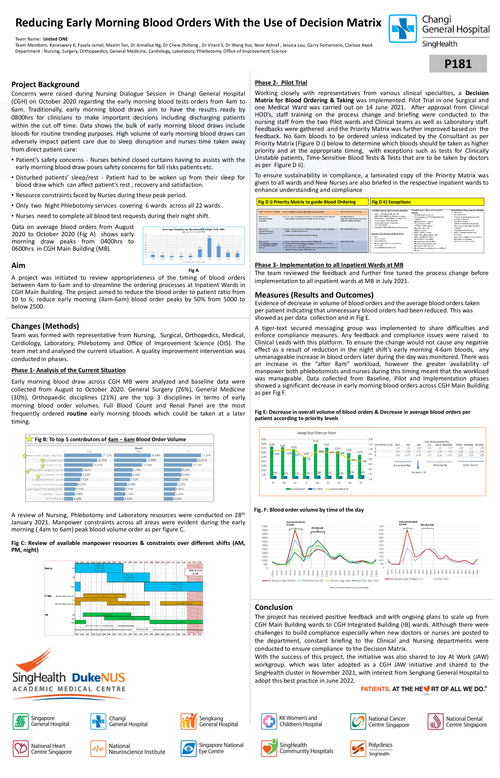
Data on average blood orders from August 2020 to October 2020 shows early morning draw peaks from 0400hrs to 0600hrs in CGH Main Building (MB).
PROJECT AIM
A project was initiated to review appropriateness of the timing of blood orders between 4am to 6am and to streamline the ordering processes at Inpatient Wards in CGH Main Building. The project aimed to reduce the blood order to patient ratio from 10 to 6; reduce early morning (4am-6am) blood order peaks by 50% from 5000 to below 2500.
METHODS
Team was formed with representative from Nursing, Surgical, Orthopedics, Medical, Cardiology, Laboratory, Phlebotomy and Office of Improvement Science (OIS). The team met and analysed the current situation. A quality improvement intervention was conducted in phases.
Phase 1- Analysis of the Current Situation
Early morning blood draw across CGH MB were analyzed and baseline data were collected from August to October 2020. General Surgery (26%), General Medicine (30%), Orthopaedic disciplines (21%) are the top 3 disciplines in terms of early morning blood order volumes. Full Blood Count and Renal Panel are the most frequently ordered routine early morning bloods which could be taken at a later timing.
A review of Nursing, Phlebotomy and Laboratory resources were conducted on 28th January 2021. Manpower constraints across all areas were evident during the early morning ( 4am to 6am) peak blood volume order.
Phase 2- Pilot Trial
Working closely with representatives from various clinical specialties, a Decision Matrix for Blood Ordering & Taking was implemented. Pilot Trial in one Surgical and one Medical Ward was carried out on 14 June 2021. After approval from Clinical HOD’s, staff training on the process change and briefing were conducted to the nursing staff from the two Pilot wards and Clinical teams as well as Laboratory staff. Feedbacks were gathered and the Priority Matrix was further improved based on the feedback. No 6am bloods to be ordered unless indicated by the Consultant as per Priority Matrix to determine which bloods should be taken as higher priority and at the appropriate timing, with exceptions such as tests for Clinically Unstable patients, Time-Sensitive Blood Tests & Tests that are to be taken by doctors
To ensure sustainability in compliance, a laminated copy of the Priority Matrix was given to all wards and New Nurses are also briefed in the respective inpatient wards to enhance understanding and compliance
Phase 3- Implementation to all Inpatient Wards at MB
The team reviewed the feedback and further fine tuned the process change before implementation to all inpatient wards at CGH MB in July 2021.
RESULTS
Evidence of decrease in volume of blood orders and the average blood orders taken per patient indicating that unnecessary blood orders had been reduced.
A tiger-text secured messaging group was implemented to share difficulties and enforce compliance measures. Any feedback and compliance issues were raised to Clinical Leads with this platform. To ensure the change would not cause any negative effect as a result of reduction in the night shift’s early morning 4-6am bloods, any unmanageable increase in blood orders later during the day was monitored. There was an increase in the “after 8am” workload, however the greater availability of manpower both phlebotomists and nurses during this timing meant that the workload was manageable. Data collected from Baseline, Pilot and Implementation phases showed a significant decrease in early morning blood orders across CGH Main Building
CONCLUSION
The project has received positive feedback and with ongoing plans to scale up from CGH Main Building wards to CGH Integrated Building (IB) wards. Although there were challenges to build compliance especially when new doctors or nurses are posted to the department, constant briefing to the Clinical and Nursing departments were conducted to ensure compliance to the Decision Matrix.
With the success of this project, the initiative was also shared to Joy At Work (JAW) workgroup, which was later adopted as a CGH JAW initiative and shared to the SingHealth cluster in November 2021, with interest from Sengkang General Hospital to adopt this best practice in June 2022.