708 posters, 8 topics, 16 sessions, 1,190 authors, 600 institutions
ePostersLive by SciGen Technologies S.A. All rights reserved.
ISQua's 39th International Conference 2023
August 27 - 30, 2023 | Seoul, Republic of Korea

P172
APPLICATION OF PREVENTING RISKS OF INFECTIONS AND MEDICATION ERRORS IN IV THERAPY (PRIME) PROGRAM: A DESCRIPTIVE STUDY
Poster Presenter
Authors
Eunjin Kim, Eunwha Lee, Eunju Cho, Hyunsook Moon, Heejin Kim, Jin Sook Kim, Sora Park, Mi Hye Kwon, Hyeunsoo Lee, Hyun Ah Lee
Affiliations
Ewha Womans University Seoul Hospital, QPS team, Ewha Womans University Seoul Hospital, Seoul, South Korea, Department of Nursing, Ewha Womans University Seoul Hospital, Seoul, South Korea
Part of Topic
Patient Safety & Quality Improvement
APPLICATION OF PREVENTING RISKS OF INFECTIONS AND MEDICATION ERRORS IN IV THERAPY (PRIME) PROGRAM : A DESCRIPTIVE STUDY
INTRODUCTION
• World Health Organization declared "Medication Safety" as the theme for World Patient Safety Day 2022 and urged stakeholders to make proactive efforts to prevent medication errors [1]. In South Korea, about 30% of patient safety accidents reported through Korea Patient Safety Reporting & Learning System every year have been analyzed as medication errors [2]. Particularly, intravenous (IV) therapy is one of the most common invasive procedures in hospital care settings, where various medication errors and complications can occur [3].
• In 2017, Joint Commission International (JCI) with sponsorship from Becton, Dickinson and Company (BD) designed the PRIME Program for training nurses on IV therapy. Although the PRIME program has been applied to several hospitals in Asia, little is known about its outcomes.
AIM
• To describe the compliance rate of the PRIME Program over 6 months; to compare the incidence rate of reported medication errors before and after program initiation.
METHOD
Design and Setting
• This study is a descriptive study with a convenience sampling method.
• The program was implemented across 28 nursing units, which included general wards, ICU, ED, and OPD at Ewha Womans University Seoul Hospital, a general hospital, between June and November 2022.
Participants and Procedure
• The PRIME program used a train-the-trainer approach.
• The "PRIME leaders", consisting of nursing administrators, QPS team and infection control team members translated the original "PRIME audit tool" developed by JCI into Korean, with minor revisions considering the hospital's policy and domestic conditions.
• BD clinical specialists trained the “PRIME champions”, 1 to 2 nurses from each unit (mainly nurse managers or charge nurses) who trained frontline “unit nurses” and monitored them every month based on the audit tool.
• A total of 381 unit nurses agreed to participate.
• The PRIME audit tool consisted of 45 items addressing the following components: 1) medication preparation and administration and 2) placement and maintenance of vascular access devices (VADs).
• On average, about 120 cases were monitored each month.
Outcomes and Data Analysis
• Outcome 1: The monthly compliance rates of the PRIME program measured by the PRIME audit tool were analyzed with descriptive statistics.
• Outcome 2: The incidence rates of reported medication errors* (per 1,000 inpatient days and per 10,000 outpatient visits, respectively) before and after program initiation were compared using MedCalc (version 22). *defined as adverse events that occurred during medication preparation and administration
Improvement Activities
• The PRIME leaders implemented the following improvement activities recommended by a JCI consultant via monthly teleconferences:
1) Standardization of Statlock replacement intervals by adopting a separately packaged Statlock;
2) Revision of hospital policy to encourage the use of prefilled normal saline syringes across all departments;
3) Sterilization of commercial disinfectants not gamma irradiated;
4) Sharing educational materials about proper techniques for breaking an ampule, the CLABSI bundle, etc.
Ethical Consideration
• This study was approved by the Institutional Review Board of Ewha Womans University Seoul Hospital (IRB No. 2022-05-018-002).
RESULTS
Outcome 1: Compliance Rate of the PRIME Program
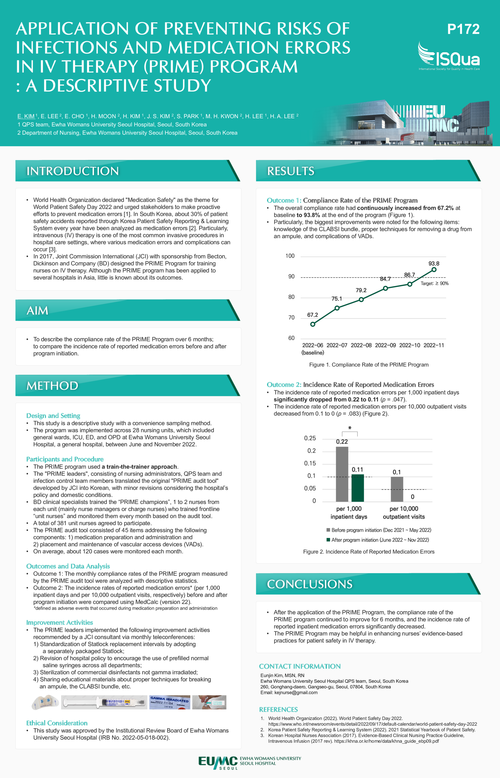
• The overall compliance rate had continuously increased from 67.2% at baseline to 93.8% at the end of the program (Figure 1).
• Particularly, the biggest improvements were noted for the following items: knowledge of the CLABSI bundle, proper techniques for removing a drug from an ampule, and complications of VADs.
Outcome 2: Incidence Rate of Reported Medication Errors
• The incidence rate of reported medication errors per 1,000 inpatient days significantly dropped from 0.22 to 0.11 (p = .047).
• The incidence rate of reported medication errors per 10,000 outpatient visits decreased from 0.1 to 0 (p = .083) (Figure 2).
CONCLUSIONS
• After the application of the PRIME Program, the compliance rate of the PRIME program continued to improve for 6 months, and the incidence rate of reported inpatient medication errors significantly decreased.
• The PRIME Program may be helpful in enhancing nurses’ evidence-based practices for patient safety in IV therapy.