708 posters, 8 topics, 16 sessions, 1,190 authors, 600 institutions
ePostersLive by SciGen Technologies S.A. All rights reserved.
ISQua's 39th International Conference 2023
August 27 - 30, 2023 | Seoul, Republic of Korea

P170
EMERGENCY CART STANDARDIZATION IN EFFICIENT WAYS FOR PATIENT-SAFETY: QUALITY IMPROVEMENT ACTIVITY EXPERIENCE
Poster Presenter
Authors
Sang Hoon NA, Eunhye KIM, Sunyoung YUN, Sulhee KIM, Eunhee JUNG, Eunju CHO, Hyojung HAN
Affiliations
Part of Topic
Patient Safety & Quality Improvement
Emergency Cart Standardization in Efficient Ways for patient-safety: Quality Improvement Activity Experience
Sang-Hoon Na, Eunhye Kim, Sunyoung Yun, Sulhee Kim, Eunhee Jung, Eunju Cho, Hyojung Han
1. Introduction
Adequate management in unexpected emergent situations during hospitalization is an important factor in patient safety. An emergency cart (E-cart) is essential equipment for storing emergency instruments such as a defibrillator and drugs (epinephrine, inotropic, etc.). Using disorganized emergency carts may negatively impact performance during an emergency situation, which is related to patient safety. Therefore, this quality improvement (QI) activity was intended to standardize emergency carts for ensuring patient safety and providing high-quality care.
2. Methods
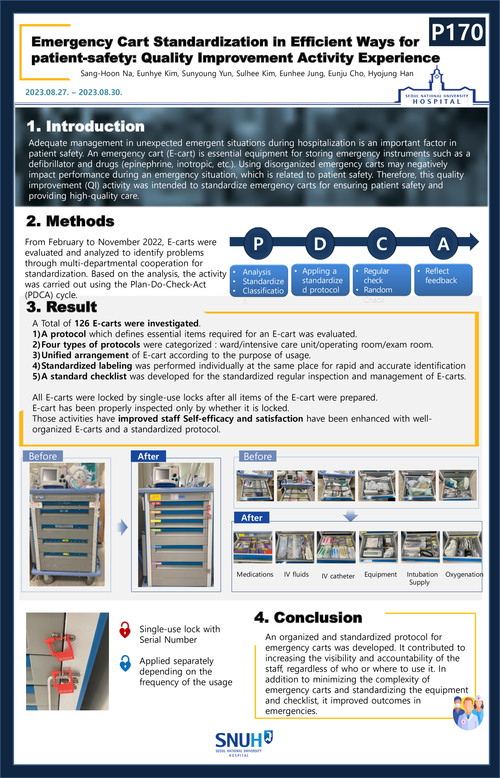
From February to November 2022, E-carts were evaluated and analyzed to identify problems through multi-departmental cooperation for standardization. Based on the analysis, the activity was carried out using the Plan-Do-Check-Act (PDCA) cycle.
3. Result
A Total of 126 E-carts were investigated.
All E-carts were locked by single-use locks after all items of the E-cart were prepared.
E-cart has been properly inspected only by whether it is locked.
Those activities have improved staff Self-efficacy and satisfaction have been enhanced with well-organized E-carts and a standardized protocol.
4. Conclusion
An organized and standardized protocol for emergency carts was developed. It contributed to increasing the visibility and accountability of the staff, regardless of who or where to use it. In addition to minimizing the complexity of emergency carts and standardizing the equipment and checklist, it improved outcomes in emergencies.